Coconut Grove vs Coral Gables: Which Miami Neighborhood Should You Buy In?
A direct comparison of Miami's two upscale family neighborhoods. Coconut Grove — bohemian bayfront village with marinas and historic charm. Coral Gables — meticulously planned Mediterranean Revival city, prestigious schools, U-Miami home. Real prices, demographics, schools, lifestyle, and who each is built for.

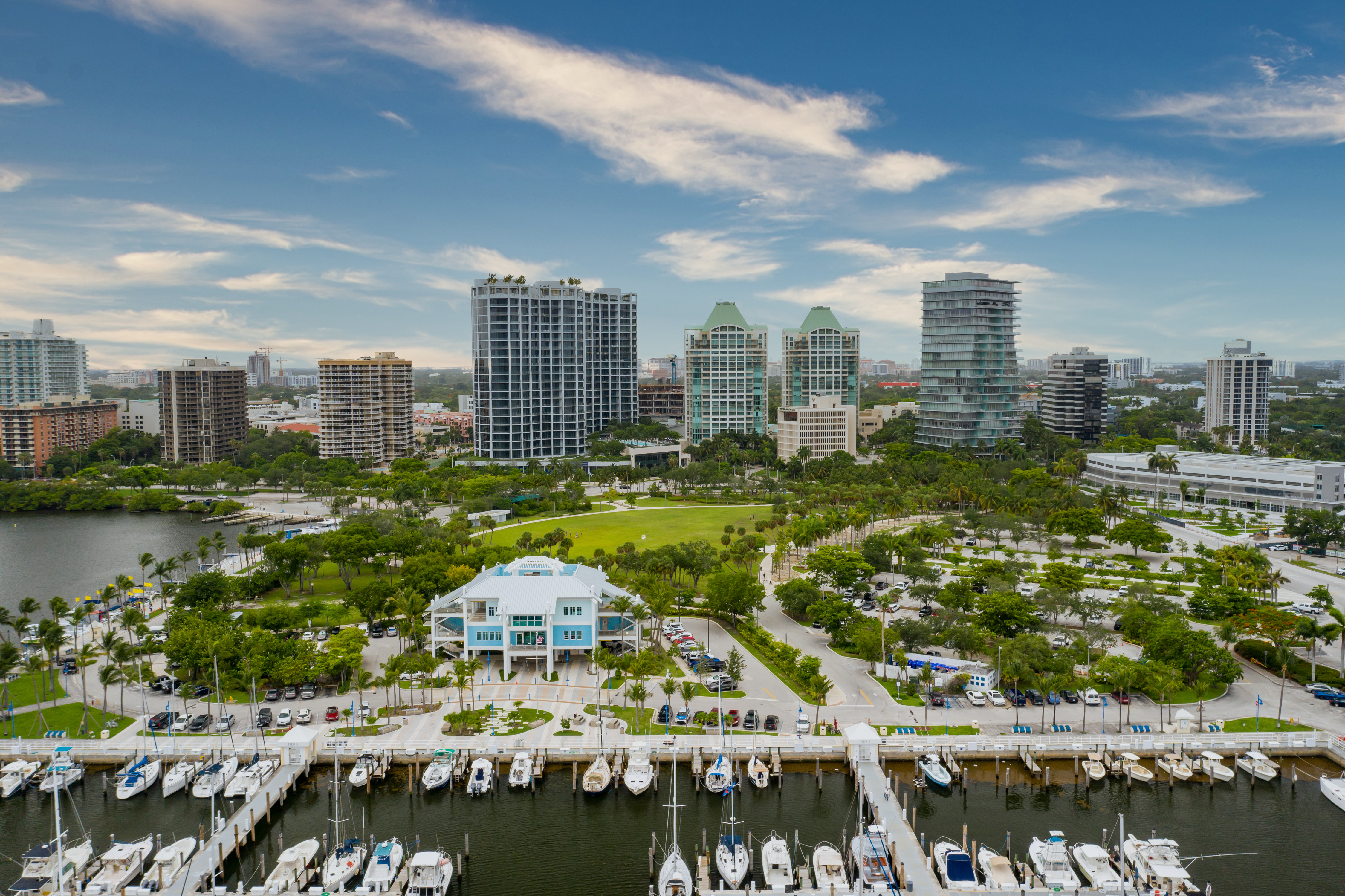
Coconut Grove vs Coral Gables: Which Miami Neighborhood Should You Buy In?
If you're shopping for a Miami home — single-family, townhouse, or boutique luxury condo — and you've ruled out the high-rise corridors (Brickell, Edgewater, Sunny Isles, South Beach), two neighborhoods almost always make the short list: Coconut Grove and Coral Gables.
They're both upscale, both family-friendly, both inland or quasi-inland, and both feature the kind of mature tree canopy and walkable village pockets you can't find in newer Miami construction. Most buyers cross-shopping them assume they're interchangeable.
They aren't. Coconut Grove and Coral Gables are different worlds — different aesthetic discipline, different demographic, different building stock, different reasons to live there. This guide walks the difference.
The Quick Answer
Pick Coconut Grove if you want a bayfront village feel, sailing or marina life, mature tree canopy, a more bohemian / arts-leaning community, smaller-scale daily life, and you don't mind being on the south end of the Miami metro. Best for sailors, families who want a slightly less formal aesthetic, and second-home buyers who value walkability to a real village center.
Pick Coral Gables if you want architectural uniformity (Mediterranean Revival enforced citywide), the strongest concentration of prestigious schools in Miami-Dade, larger single-family lot sizes, proximity to the University of Miami, and a more formal upscale civic culture. Best for families with school-age children prioritizing K–12 outcomes, traditional luxury buyers, and professionals working at U-Miami / Mercy Hospital / the local banking corridor.
Geography & Character
Coconut Grove sits on Biscayne Bay just south of downtown Miami and Brickell, roughly 15 minutes from downtown without traffic. It runs along the bay from Mercy Hospital south to the Vizcaya Museum and inland to the U.S. 1 corridor. The Grove is one of the oldest continuously settled neighborhoods in Miami — established in the late 1800s and still defined by Bahamian and bohemian roots, with mature banyan, oak, and royal poinciana canopy that defines the look of nearly every street.
Coral Gables sits southwest of Coconut Grove, bounded roughly by U.S. 1 to the east, the South Miami line to the south, the Palmetto Expressway to the west, and the Miami River corridor to the north. It's a meticulously planned Mediterranean Revival city — every commercial building on Miracle Mile, every public fountain, every street sign, every residential development is governed by the city's design code, written in 1925 by George Merrick when he founded the city. The result: visual consistency you don't see anywhere else in Miami.
Character difference: the Grove is village-and-bay; the Gables is city-and-canopy. The Grove has a small walkable commercial core (CocoWalk, Main Highway, Commodore Plaza) surrounded by residential. The Gables has a larger and more distributed commercial pattern — Miracle Mile / Giralda Plaza for retail, the U-Miami area, the Coral Gables Country Club zone, and several boutique commercial streets.
The Numbers (Side by Side)
| Coconut Grove | Coral Gables | |
|---|---|---|
| Population | ~22,000 | ~49,000 |
| Median age | 40 | 41 |
| Median household income | $105,000 | $125,000 |
| Average home price | $950,000 | $1,250,000 |
| Price per sq ft | $720 | $520 |
| Median rent | $3,800 | $3,800 |
| Rent per sq ft | $3.50 | $2.90 |
| Active inventory | ~480 listings | ~850 listings |
| Months of inventory | 5.1 | 6.2 |
| YoY price change | +8.7% | +9.5% |
| Walk Score | 75 | 60 |
| Transit Score | 45 | 40 |
| Bike Score | 80 | 65 |
| Crime rating | A | A |
| School rating | A | A |
| Nightlife rating | 3/5 | 3/5 |
| Restaurant rating | 4/5 | 5/5 |
| Shopping rating | 4/5 | 5/5 |
Reading the numbers:
- Coral Gables' inventory is 1.8x Coconut Grove's and the city is roughly 2.2x larger by population. Larger market = more comp depth and easier exit pricing.
- Coral Gables looks more expensive on average price ($1.25M vs $950K) but cheaper per square foot ($520 vs $720). That's because Gables' inventory is heavier on larger single-family homes on bigger lots — average $/sqft drops because the square footage grows faster than absolute price. The Grove's inventory leans more toward smaller historic cottages and bayfront condos, which carry higher $/sqft.
- Same median rent ($3,800) but very different rent-per-sqft. Grove rentals are smaller, so they earn higher $/sqft.
- Both score A on schools and crime. This is the headline reason both make the family short list.
- Coral Gables wins shopping and dining ratings. Miracle Mile + Merrick Park are denser than CocoWalk + Main Highway.
- Grove wins walkability + bikeability. The village core is more compact and the bayfront promenade makes it walkable in a way Gables isn't.
- Both are car-dependent on transit. Neither is built for transit commuting (compare with Brickell at 90).
Building Stock & Real Estate
Coconut Grove
Three product types dominate Coconut Grove real estate:
1. Historic single-family homes. The Grove's residential streets — Main Highway, Loquat Avenue, Tigertail Avenue, the Camp Biscayne historic district — are full of restored 1920s-1940s wood-frame cottages, coral rock houses, and Bahamian-Caribbean influenced architecture. Prices range from ~$1.5M for a 2-bed restored cottage to $20M+ for compound estates on the bay or with deep waterfront.
2. Bayfront and near-bayfront condos. The Grove has a meaningful luxury condo footprint along Bayshore Drive and South Bayshore Drive. Notable buildings:
- Ritz-Carlton Residences Coconut Grove — operated hotel-branded existing
- Four Seasons Residences Coconut Grove — operated hotel-branded pre-construction
- Grove at Grand Bay — twin Bjarke Ingels-designed towers, instantly recognizable
- Park Grove — Related Group's three-tower complex
- Vita at Grove Isle — newer ultra-luxury private-island development
3. Recent boutique infill condos in the village core, generally smaller (under 50 units), urban-village in scale.
See the Coconut Grove best buildings ranking for the full curated list.
Coral Gables
Coral Gables real estate is dominantly single-family, with a smaller condo footprint:
1. Single-family homes are the headline product. The Gables has some of the largest residential lots in Miami-Dade — ½-acre to 2-acre estates are common in the Old Cutler Road corridor, Hammock Lakes, the Country Club area, and around Granada Boulevard. Pricing spans $1.5M (smaller cottages on 6,000–10,000 sqft lots) to $50M+ (historic estates on the bay or Biltmore-adjacent).
2. Mid-rise and boutique condos, mostly along the southern edge of the city near U-Miami and along the U.S. 1 corridor. Notable inventory tends to be 4–12 story buildings rather than high-rises (the Gables zoning code generally caps building heights).
3. New mid-rise infill has accelerated along Le Jeune Road and around Merrick Park (Shops at Merrick Park, the Village of Merrick Park residences) — these are mid-rise condos catering to professional buyers who want Gables address without single-family maintenance.
See the Coral Gables best buildings ranking for the curated condo list.
Building-stock takeaway: if you specifically want a luxury condo with hotel-branded service, Coconut Grove has more options at the ultra-luxury tier (Ritz-Carlton, Four Seasons, Grand Bay). If you want a single-family home with a real lot, Coral Gables has materially more inventory and more variety in lot size, era, and architectural style.

Schools
Both neighborhoods score A on overall school rating, but the texture differs.
Coconut Grove's public schools: Coconut Grove Elementary (A-rated) is widely regarded as one of Miami-Dade's strongest public elementary schools. Public middle and high school zoning varies and most luxury families either send children to private school or magnet schools. Major private options in or adjacent to Coconut Grove:
- Ransom Everglades School (PreK–12, ~$45K tuition, top academic ranking in Florida)
- Carrollton School of the Sacred Heart (girls, Catholic, K–12)
- Coconut Grove Montessori School
- St. Stephen's Episcopal Day School
Coral Gables' public schools: Coral Gables Senior High is a strong public option and the Gables zoning includes several high-rated elementary and middle schools. Even more notably, Coral Gables is the densest concentration of prestigious private K–12 schools in Miami-Dade:
- Gulliver Academy and Gulliver Preparatory School (separate campuses, top academic + athletic ranking)
- Riviera Schools (private, ~PreK–8)
- Westminster Christian School
- St. Theresa Catholic School
- Belen Jesuit Preparatory is technically adjacent (West Kendall) and a Gables-adjacent option
- University of Miami's faculty K–12 affiliates plus undergraduate / graduate proximity for buyers with U-Miami connections
Practical take: for K-12 outcomes, especially private school, Coral Gables has a meaningfully deeper school option set within a 10-minute drive. Coconut Grove parents often drive to Coral Gables schools anyway. If your school strategy is "send to the best private school within a reasonable commute," Coral Gables wins on convenience.
Dining, Shopping, Culture
Coral Gables wins dining and shopping density. Two major commercial cores:
- Miracle Mile + Giralda Plaza — The classic Gables shopping strip, recently pedestrianized for Giralda Plaza. Dense restaurant cluster (Bachour, Bulla Gastrobar, Talavera, Caffe Vialetto, Doce Provisions, the rooftop scene at La Provence). The Aragon Avenue dining strip is another concentration.
- Shops at Merrick Park — open-air upscale mall anchored by Neiman Marcus and Nordstrom, with Tiffany, Burberry, fine dining options. Effectively the Gables' luxury shopping anchor.
The Gables also has the Biltmore Hotel (historic, with classic dining), Coral Gables Country Club, Coral Gables Museum, and is increasingly the home of the South Florida visual arts gallery scene since Wynwood prices rose.
Coconut Grove's commercial scene is smaller but increasingly elevated:
- CocoWalk — relaunched in 2020 after substantial renovation; now a real dining destination with Lifetime Fitness, AC Hotel by Marriott, and a strong restaurant lineup (Bombay Darbar, Atchana's Homegrown Thai, Sapore di Mare, Glass & Vine)
- Main Highway / Grand Avenue — historic village core with smaller restaurants, galleries, the Coconut Grove Playhouse area
- Coconut Grove Sailing Club, Coral Reef Yacht Club, Biscayne Bay Yacht Club — yachting culture is central to Grove daily life in a way that Gables doesn't have
For pure quantity of dining/shopping, Coral Gables wins. For waterfront / yachting culture, Coconut Grove wins clearly.
Lifestyle & Cultural Vibe
This is the softest section but matters most for the buyers who get the decision wrong.
Coconut Grove vibe: bohemian-historic-bayfront. Tree canopy you can hear in the breeze. Boats. Bahamian and Caribbean cultural roots. Less formal — flip-flops at brunch is fine on a Sunday. Recurring waterfront events (Coconut Grove Arts Festival, the Grand Prix and boat shows on the bay, regular regattas). Architecture is varied — historic wood frame next to mid-century, next to a contemporary Walter Defour design, next to a coral rock cottage. Looks lived-in, looks weathered, looks unique.
Coral Gables vibe: architecturally formal, civic, planned. Streets named in Spanish, fountains where intersections meet, no commercial signage out of code, no neon. Recurring civic culture (Coral Gables Art on the Avenue, food and wine events at the Biltmore, the Junior Orange Bowl). Architecture is uniform — every building Mediterranean Revival or compatible. Looks intentional, looks designed, looks composed.
If you've ever been frustrated by an HOA that polices fence colors, you might find Coral Gables' city-wide architectural review code annoying. If you appreciate the visual coherence of a planned aesthetic, the Gables is unmatched in Florida.
If you're a person whose ideal Saturday involves a 30-foot sailboat and dinner at a slightly imperfect place with a great view, the Grove fits. If your ideal Saturday is a private golf round and dinner at a polished Miracle Mile bistro, the Gables fits.
Investment & Market Dynamics
Both have steady appreciation but different dynamics:
Coconut Grove:
- 8.7% YoY appreciation
- Higher $/sqft ($720) reflects smaller lot sizes and condo-heavy newer inventory
- Bayfront premium is the key driver — direct bay frontage trades at meaningful premium over non-bay
- Months of inventory: 5.1 (slightly tight)
- Rental yields are decent for condos (especially Grove condo product near the village center)
- Single-family rental yields are weak — most Grove SFH carries land value premium that suppresses cap rate
Coral Gables:
- 9.5% YoY appreciation
- Lower $/sqft ($520) — driven by SFH-dominant inventory with larger square footage
- Long-term thesis is the architectural moat: as the Mediterranean Revival code limits inventory growth, scarcity drives appreciation
- Months of inventory: 6.2 (more balanced market)
- Rental yields generally weak for SFH; mid-rise condos at Merrick Park area offer better yields
- The Gables economy diversifies risk — U-Miami, Mercy Hospital, the banking corridor (legacy international banking institutions), and the consular district drive a more diverse employment base than purely-residential neighborhoods
Rough investor verdict: Coconut Grove for waterfront premium + Grove village walkability premium. Coral Gables for architectural scarcity + larger lots + family rental demand around U-Miami.
Who Coconut Grove Is For
- The sailor / boater / bayfront enthusiast. Three major yacht clubs, the deepest concentration of marinas in greater Miami, immediate bay access. If you own a boat, the Grove is unbeatable.
- The "I want a real village" buyer. Walk to dinner from your house, see the same people at the same coffee shop, watch your kids ride bikes to Coconut Grove Elementary. The Grove is the closest Miami gets to a village.
- The buyer who wants character over uniformity. Historic homes, mature canopy, bohemian heritage. Less polished, more soul.
- The condo buyer at the ultra-luxury tier who wants hotel-branded service in a residential village context (Ritz-Carlton, Four Seasons, Grand Bay).
- The second-home buyer who wants Miami-but-not-Miami-Beach. The Grove has tropical authenticity South Beach doesn't.
Who Coral Gables Is For
- The school-optimizing family. Densest concentration of prestigious K-12 private schools in Miami-Dade, plus strong public zoning. If your decision criteria are 80% schools, Coral Gables wins.
- The traditional luxury buyer. Larger lots, Mediterranean Revival aesthetic, mature canopy, civic gravitas. The Gables is what people picture when they say "old Miami money."
- The U-Miami affiliated family. Professors, doctors at Bascom Palmer / Mercy / Sylvester Comprehensive Cancer Center, students' families. The Gables is the natural fit.
- The buyer who wants single-family scale without the maintenance overhead of a 5-acre suburban property. The Gables has plenty of 8,000–15,000 sqft lots that feel substantial without being unmanageable.
- The professional working in the international banking corridor. Several Latin American consulates and banks anchor in the Gables, and the corporate base means professionals who want to live near the office often choose the Gables.
Frequently Asked Questions
Q: Which is more expensive, Coconut Grove or Coral Gables? A: Depends on the metric. By average price Coral Gables is higher ($1.25M vs $950K) — but only because Gables inventory includes larger single-family homes with bigger square footage. On a per-square-foot basis, Coconut Grove is meaningfully more expensive ($720 vs $520). Compare same-product to same-product: a 3-bed condo in either neighborhood lands in a similar absolute range; a single-family home with comparable lot and finish reflects the local $/sqft difference.
Q: Which has better schools? A: Both A-rated overall. Coral Gables wins on private-school density (Gulliver, Westminster, Riviera, St. Theresa, Belen Jesuit adjacent). Coconut Grove parents often drive to Coral Gables schools regardless. For pure public-school strength, Coconut Grove Elementary is one of Miami-Dade's strongest elementaries.
Q: Is Coconut Grove safe? A: Yes — A crime rating, one of Miami's safer neighborhoods. The historic boundaries of Coconut Grove proper are well-policed and have low incident rates. The West Grove (West Coconut Grove / Black Grove) historically had higher incident rates but has gentrified meaningfully over the past decade.
Q: Can I walk to dinner in either neighborhood? A: Coconut Grove yes, easily, from most Grove residential addresses to CocoWalk or Main Highway. Coral Gables yes from addresses within walking distance of Miracle Mile or Giralda Plaza, but the Gables is geographically larger so many residential streets aren't walking distance to commercial.
Q: Which has better appreciation potential? A: Both have momentum. Coral Gables's appreciation thesis is the architectural code limiting new inventory + family demand from school quality. Coconut Grove's thesis is bayfront scarcity + condo product at the ultra-luxury end. Both have been strong; neither shows signs of softening.
Q: Is one better for short-term rental? A: Coral Gables explicitly restricts short-term rentals in most zoning. Coconut Grove varies by building / association — most luxury condos restrict, but enforcement varies. Neither is a strong short-term rental market overall — both lean long-term annual.
Q: Can I live in Coral Gables without a car? A: Difficult. The Gables is large and car-dependent — most addresses are not walking distance to commercial cores or transit. Coconut Grove is somewhat more walkable in the village core but also generally car-dependent. Neither is comparable to Brickell or South Beach for car-free living.
Q: Which has better dining? A: Coral Gables on density and quality — Miracle Mile, Merrick Park, Giralda Plaza, and Aragon Avenue create the densest fine-dining cluster south of Brickell. Coconut Grove has fewer options but stronger waterfront / village character (Bombay Darbar, Glass & Vine, the bayfront dining at the marinas).
Q: How are property taxes different? A: Coral Gables is its own city and levies an additional municipal property tax on top of Miami-Dade County tax. Coconut Grove is unincorporated within the City of Miami and pays Miami municipal tax. Coral Gables effective rates run roughly 0.1–0.2 percentage points higher annually than equivalent Coconut Grove properties — a meaningful long-term cost difference on a $3M house.
For more on individual buildings or homes in either neighborhood, browse our Coconut Grove building directory and Coral Gables building directory. For other Miami neighborhood comparisons and broader market context, see the neighborhoods guide and the Miami real estate blog. To talk through your specific situation, get in touch.
Condo buildings in Coconut Grove
Photos, floor plans, amenities, and current units for sale and rent in each.
- Arbor Coconut Grove
- Beacon Harbour
- Cloisters on the Bay
- Four Seasons Residences Coconut Grove
- Glasshaus
- Grove at Grand Bay
- Grove Hill Tower
- Grove Towers
- Grovenor House
- Mr. C Bayshore Residences
- Mr. C Tigertail Residences
- Mutiny Park Condo
- One Grove Isle
- One Park Grove
- OPUS Coconut Grove
- Park Grove Club Residences
- Residences at Vizcaya
- Ritz-Carlton Coconut Grove
- The Fairchild Coconut Grove
- The Lincoln Coconut Grove
- The Well Coconut Grove
- Three Grove Isle
- Two Grove Isle
- Two Park Grove
- Vita at Grove Isle
- Yacht Harbour
- Ziggurat
Tags
Related Articles
Aventura vs Sunny Isles: Which Northern Miami Neighborhood Should You Buy In?
Direct comparison of two adjacent northern Miami-Dade neighborhoods that look similar on a map and aren't. Aventura — mainland city built around Aventura Mall and Williams Island, family-skewing, A-rated schools. Sunny Isles — barrier-island Atlantic beachfront tower corridor with Porsche, Bentley, Ritz, Armani, Trump. Prices, schools, lifestyle, who each fits.
Brickell vs Downtown Miami: Which Urban Core Condo Should You Buy?
A direct comparison of Miami's two adjacent downtown condo districts. Brickell — the established financial district with denser amenities and higher prices. Downtown Miami — the rapidly developing Worldcenter / Aston Martin / Waldorf corridor with lower entry prices and the highest transit score in Miami. Real prices, buildings, lifestyle, and who each fits.
Key Biscayne vs Fisher Island: Which Miami Island Life Is Right for You?
A direct comparison of Miami's two most exclusive island communities. Key Biscayne — bridge-accessible barrier island family community with A-rated schools, ocean and bay frontage, and Crandon Park. Fisher Island — America's wealthiest zip code, accessible only by ferry, yacht, or helicopter, with 830 residents and average prices above $6M.