Key Biscayne vs Fisher Island: Which Miami Island Life Is Right for You?
A direct comparison of Miami's two most exclusive island communities. Key Biscayne — bridge-accessible barrier island family community with A-rated schools, ocean and bay frontage, and Crandon Park. Fisher Island — America's wealthiest zip code, accessible only by ferry, yacht, or helicopter, with 830 residents and average prices above $6M.

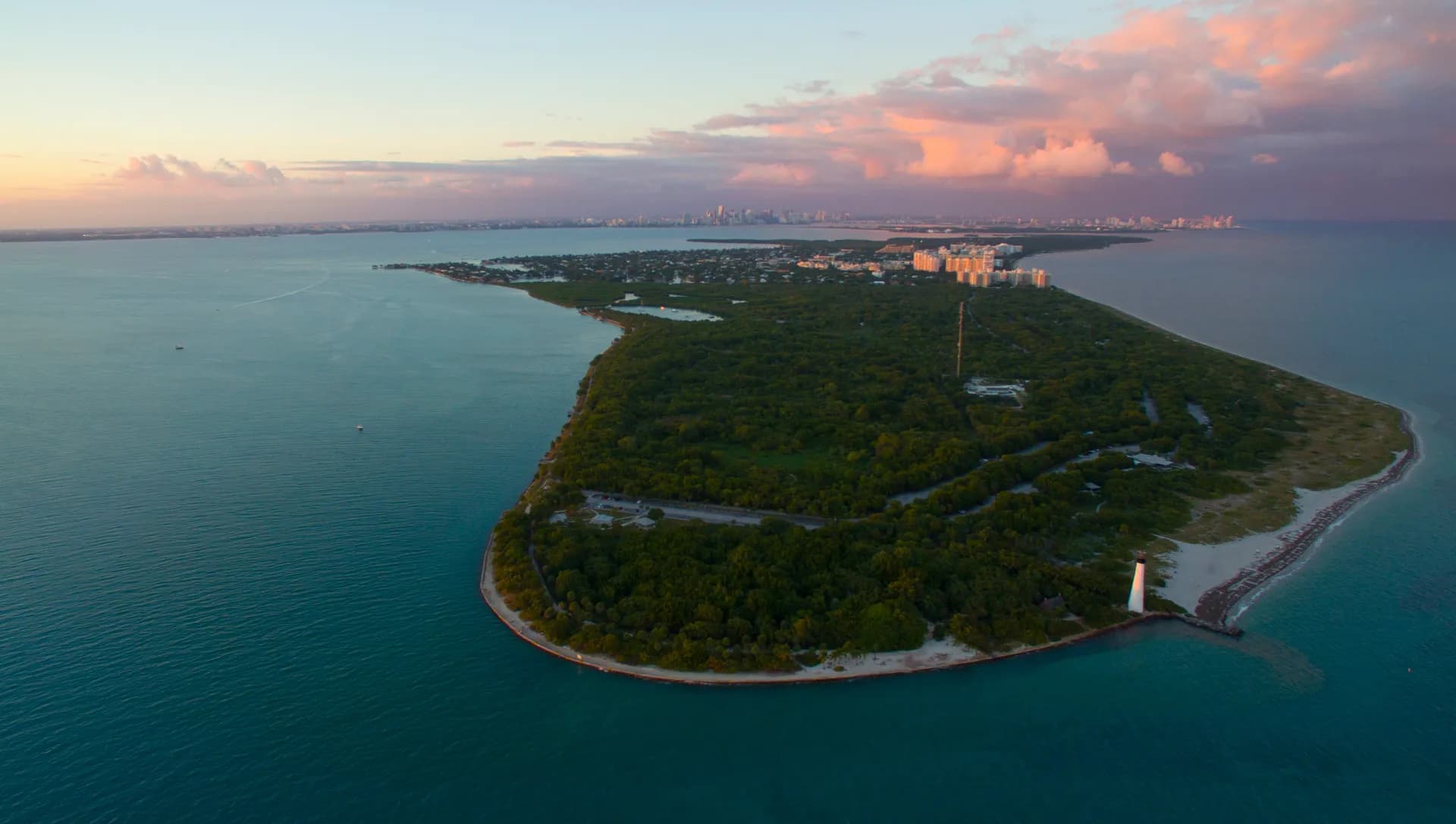
If your Miami real estate criteria include the words "island," "exclusive," and "private," two places top your short list: Key Biscayne and Fisher Island.
Both are physically isolated from mainland Miami. Both have meaningfully higher household incomes than any non-island Miami neighborhood. Both are A-rated for schools and crime. From outside the gates, they look like equivalent expressions of the same Miami-island-lifestyle concept.
They're not the same thing. Key Biscayne is a family-oriented barrier island community connected by a long causeway to mainland Coconut Grove — open to the public, with restaurants, parks, hotels, and ~14,000 residents. Fisher Island is a 216-acre private resort community accessible only by 7-minute ferry from MacArthur Causeway (or by private yacht / helicopter), with just 830 permanent residents and the highest reported average household income of any zip code in the United States.
This guide is the comparison. Real numbers, real lifestyle differences, and a clear take on who each is built for.
The Quick Answer
Pick Key Biscayne if you want bridge-accessible barrier-island living with day-to-day services (grocery stores, restaurants, schools, parks) inside the community, an A-rated public school system, both Atlantic and bay frontage, and a connected lifestyle (your kids can take a school bus, you can drive to Coconut Grove for dinner). Best for families, primary residents who actually live their daily life here, and buyers who want island feel without complete isolation.
Pick Fisher Island if you want genuine privacy and exclusivity, the most curated island resort community in the United States, access only by ferry / yacht / helicopter, ultra-luxury condo product with average prices above $6M, and the very highest concentration of wealth in greater Miami. Best for ultra-high-net-worth buyers, primary or second-home residents who prioritize total privacy, and buyers who treat their address as a financial / status statement as much as a residence.
Geography & Access
Key Biscayne is a barrier island roughly 5 miles offshore from Coconut Grove, connected to mainland Miami by the Rickenbacker Causeway (which crosses Virginia Key first). The Village of Key Biscayne itself is the main residential community on the island; the southern third is Bill Baggs Cape Florida State Park and the northern portion includes Crandon Park. The Rickenbacker Causeway tolls (~$2) and adds 15–20 minutes to any mainland trip. Driving is the only access method — there's no ferry, no rail, no airport landing.
Fisher Island is a 216-acre private island just south of Miami Beach, separated from MacArthur Causeway by Government Cut. The only ways to reach Fisher Island:
- Fisher Island Ferry — 7-minute crossing from a private dock on MacArthur Causeway, every 15 minutes, restricted to residents/guests with verified credentials
- Private yacht — Fisher Island Marina accepts resident yachts
- Private helicopter — the island has a heliport for resident/guest use
No bridge. No public access. The ferry is staff-screened.
Character: Key Biscayne is family island village. Fisher Island is private resort community. The access difference creates almost every other practical difference between them.
The Numbers (Side by Side)
| Key Biscayne | Fisher Island | |
|---|---|---|
| Population | ~14,000 | ~830 |
| Median age | 44 | 55 |
| Median household income | $127,000 | $250,000+ |
| Average condo price | $1,850,000 | $6,120,000 |
| Price per sq ft | $750 | $1,582 |
| Active inventory | ~280 listings | ~49 listings |
| Walk Score | 30 | 74 |
| Transit Score | 30 | 32 |
| Bike Score | 80 | 60 |
| Crime rating | A | A |
| School rating | A | A |
| Nightlife rating | 1/5 | 2/5 |
| Restaurant rating | 3/5 | 5/5 |
| Shopping rating | 2/5 | 4/5 |
Reading the numbers:
- Fisher Island is 3.3x more expensive on average ($6.12M vs $1.85M) and 2.1x more expensive per square foot ($1,582 vs $750). Fisher Island has the highest reported $/sqft of any large-sample neighborhood in Miami.
- Fisher Island's median household income ($250K+) is roughly 2x Key Biscayne's ($127K) — and Fisher Island's published average household income (often quoted by Forbes / Bloomberg) regularly exceeds $2M because of the extreme top-end skew.
- Population: 14,000 vs 830 — a factor of 17x. Fisher Island is genuinely a private community at the scale of a residential club, not a town.
- Active inventory: 280 vs 49. Fisher Island's inventory is so thin that any individual transaction meaningfully moves the comp set.
- Walk Score: 74 for Fisher Island, 30 for Key Biscayne. Counterintuitive at first — but Fisher Island is so compact (216 acres) that everything is walking distance once you're on the island. Key Biscayne's barrier-island geography is long and linear; most addresses aren't walking distance to the village commercial center.
- Schools and crime: both A. Fisher Island residents typically send children to the Fisher Island Day School (PreK–6, on-island, very small classes); Key Biscayne residents use the village public schools or private options in Coconut Grove.
Access & Daily Life Differences
The access difference reshapes daily life:
Key Biscayne is connected island. School buses cross the causeway. Grocery deliveries arrive routinely. Service workers commute in. Day trippers visit Crandon Park and Bill Baggs State Park beaches. Restaurants and the village commercial core operate normal retail hours. You drive everywhere on island except short walking trips to the village center. Daily life looks like upscale suburban beach town with limited beach commercial development and a strong cohesive community.
Fisher Island is gated island. Everyone who arrives is screened. The ferry runs every 15 minutes and is the practical pulse of the island. Residents typically own a car kept on Fisher Island (small "Fisher Island Cars" are common — golf-cart-style EVs are widespread) and use a separate "mainland car" parked at the Fisher Island Lot for off-island trips. Daily life looks like exclusive resort — restaurants on-island are mostly Fisher Island Club venues, retail is limited, services come to you through the Fisher Island Club concierge program.
A Key Biscayne dinner with friends from the mainland: they drive over, you meet at a Crandon Boulevard restaurant. A Fisher Island dinner with mainland friends: you escort them through ferry security, they spend the evening on the island, you escort them back to the ferry. The frictions are different.

Building Stock
Key Biscayne
Key Biscayne is predominantly single-family homes plus a smaller luxury condo footprint. Roughly 60% of Key Biscayne housing units are single-family; the remaining 40% are condos clustered along Ocean Lane / Ocean Drive / Crandon Boulevard.
Notable condo buildings:
- Ritz-Carlton Key Biscayne — Atlantic oceanfront, Ritz-operated
- Grand Bay Residences Key Biscayne — bayfront luxury (separate from the Coconut Grove Grand Bay)
- Oceana Key Biscayne — twin-tower oceanfront, Eduardo Costantini development
- Ocean Tower — oceanfront
- Older mid-rises along Ocean Lane
Single-family homes range from $1.5M (modest) to $50M+ (waterfront estates with private docks). See the Key Biscayne best buildings ranking for the curated condo list.
Fisher Island
Fisher Island is almost entirely condominium and small-cluster villa product. The original Vanderbilt mansion (Sea View) remains as part of the Fisher Island Club; most residential units are in the planned condo developments built over the past 40 years.
Notable buildings/villas:
- Bayview — eastern bayside cluster
- Marina Village — marina-adjacent, smaller units
- Oceanside — Atlantic-facing
- Seaside Village — beach-adjacent
- Palazzo Del Sol / Palazzo Del Mare — newer ultra-luxury
- The Links Estates — golf-course-adjacent villas
- Six Senses Residences Fisher Island — Six Senses pre-construction, the island's next major development
See Fisher Island best buildings ranking.
Building-stock takeaway: Key Biscayne has more product variety (single-family, mid-rise condo, high-rise condo, hotel-branded). Fisher Island is narrower but more uniformly ultra-luxury. Single-family is not really an option on Fisher Island in the conventional sense; almost all units are condos or attached villas.
Schools
Both A-rated — but the underlying systems are completely different.
Key Biscayne is part of the Miami-Dade County Public Schools system with K–8 zoned to Key Biscayne K-8 Center (A-rated) and high school zoned to MAST Academy on Virginia Key (also A-rated, magnet-focused). Plus immediate proximity to Coconut Grove private schools (Ransom Everglades, Carrollton, Coconut Grove Montessori) — many Key Biscayne families drive across the causeway for private school.
Fisher Island has Fisher Island Day School (PreK–6) on-island with small class sizes (typically under 100 students total) and strong academic outcomes. After 6th grade, Fisher Island families either:
- Send to Carrollton, Ransom Everglades, or other Coconut Grove / Coral Gables private schools (involves daily ferry commute)
- Send to boarding school
- Use Miami Beach private schools (Lehrman Community Day School)
Practical school takeaway: Both function well at the elementary level. Key Biscayne is more sustainable through high school without involving a ferry; Fisher Island's older-children plan typically involves either off-island private school commuting or boarding school.
Lifestyle & Daily Texture
Key Biscayne is family island village:
- Daily life centers on the school run, the village commercial core (Crandon Boulevard restaurants), Crandon Park beach (massive public beach), Bill Baggs Cape Florida State Park
- Annual events include the Miami Open at the Hard Rock Stadium (was previously on Key Biscayne at Crandon Park), the Key Biscayne 4th of July celebration, regular Key Biscayne Yacht Club regattas
- Strong cohesive community feel — most permanent residents know each other, common civic engagement
- Beach access is at public parks rather than building-private beach clubs
- Restaurants are mid-tier upscale — Boater's Grill at Bill Baggs, Cantina Beach at Ritz-Carlton, Cioppino, several Crandon Boulevard restaurants
Fisher Island is private resort island:
- Daily life centers on the Fisher Island Club (golf, tennis, spa, beach club, multiple restaurants), the marina, the Fisher Island Day School (for families)
- Annual events are largely member-private — the Fisher Island Club's calendar of dinners, regattas, club championships
- Community is smaller and more reserved — 830 permanent residents is roughly the size of a single Key Biscayne tower's resident base
- Beach access is via Fisher Island Beach — small, sandy, with imported Bahamian sand, attended beach service
- Restaurants are largely Fisher Island Club venues — La Trattoria, Beach Club, Garwood Lounge, the spa restaurant. Limited variety but high quality.
Investment & Market Dynamics
Key Biscayne:
- 7.5% YoY appreciation (steady)
- Months of inventory: 8.5 (slower market reflecting island access friction)
- Single-family scarcity supports long-term appreciation
- Ritz-Carlton operated condo holds value through cycles
- Strong family-rental demand at the mid-tier; weaker at the ultra-luxury tier (most ultra-luxury Key Biscayne buyers are primary residents, not investors)
Fisher Island:
- Appreciation data sparse (small market, thin comp set)
- Months of inventory not reliably calculable (49 active listings across a uniquely tiny market)
- Long-term thesis leans heavily on the access moat — there's no way to "build more" Fisher Island, and the existing inventory is genuinely scarce
- Six Senses Fisher Island pre-construction is the most significant active project; delivery will create a comp event
- Rental market essentially doesn't exist in the conventional sense — most Fisher Island ownership is primary residence or second home with limited rental activity
Investor verdict: Key Biscayne for family-rental yields + single-family scarcity appreciation. Fisher Island for ultra-luxury hold + access-driven scarcity premium. Neither is a typical rental-yield market.
Who Key Biscayne Is For
- The family with school-age children who wants island living without sacrificing daily access to schools and services. Key Biscayne is the only Miami island that supports a fully connected family lifestyle.
- The active outdoor / water-sports buyer. Crandon Park, Bill Baggs, the Key Biscayne Yacht Club, kiteboarding at Hobie Beach, kayaking at the Bear Cut Preserve — Key Biscayne has the best outdoor recreation footprint of any Miami island.
- The buyer who wants island peace without complete isolation. Key Biscayne is 15 minutes from Coconut Grove and 25 minutes from Brickell — close enough for routine engagement, distant enough to feel separate.
- The pre-existing single-family home buyer. If single-family on a Miami island matters, Key Biscayne is essentially the only practical option.
Who Fisher Island Is For
- The ultra-high-net-worth buyer prioritizing absolute privacy. Ferry-only access plus Fisher Island Club's resident-screening creates a level of privacy unavailable elsewhere in Miami.
- The second-home buyer / international resident who treats Miami as one of multiple residences and wants the visit experience to be entirely curated. Fisher Island operates like a 5-star resort that you own.
- The buyer who values exclusivity as a status / identity statement. Fisher Island is widely known as America's wealthiest zip code; the address itself carries currency.
- The Six Senses / Aman-style wellness-luxury buyer (relevant post-2027 with Six Senses Fisher Island delivery).
- The buyer with private aviation / yachting infrastructure who arrives by yacht or helicopter rather than ferry routinely.
Frequently Asked Questions
Q: Which is more expensive? A: Fisher Island, by a wide margin. Average $6.12M vs $1.85M, and $1,582/sqft vs $750/sqft. Fisher Island is the most expensive zip code in greater Miami by per-square-foot metrics.
Q: Can I visit Fisher Island without being a resident? A: Only as a verified guest. The Fisher Island Ferry security screens every vehicle; non-resident access requires being on a confirmed guest list maintained by a resident or Fisher Island Club member. Day-trip visits aren't available.
Q: How do you get to Fisher Island? A: Three options: (1) Fisher Island Ferry from MacArthur Causeway (7-minute crossing, every 15 minutes for residents); (2) private yacht to Fisher Island Marina; (3) private helicopter to the on-island heliport. There is no bridge and no commercial / Uber / ride-share access.
Q: What's the deal with two cars (Fisher Island car + mainland car)? A: Most Fisher Island residents keep a small electric vehicle ("Fisher Island Car," similar to a golf cart) on the island for getting around the 216-acre community, plus a separate mainland car parked at the Fisher Island Lot on MacArthur Causeway for off-island trips. The mainland car is reached by taking the ferry over and walking to the car. This is normal Fisher Island routine.
Q: Which is better for raising children? A: Both have A-rated schools, but the lifestyle is meaningfully different. Key Biscayne's K–12 path stays on-island or nearby — kids can take a school bus, attend public school, walk to friends' houses. Fisher Island's K–6 path is on-island (Fisher Island Day School) but middle and high school typically require either off-island private school commuting (via ferry daily) or boarding school. For families committed to staying in one community through age 18, Key Biscayne is the more practical choice.
Q: Are there single-family homes on Fisher Island? A: Very few in the conventional sense. Fisher Island residential inventory is overwhelmingly condominium plus attached villa product. The Links Estates section has some larger detached units but they function more like villa-condos than traditional single-family homes.
Q: How does the Ritz-Carlton Key Biscayne compare to Fisher Island product? A: Ritz-Carlton Key Biscayne is operated luxury hotel-branded condo at the Key Biscayne-luxury tier (typically $2–10M range). Fisher Island condos at equivalent ultra-luxury tier start higher ($4M+) and the island access alone is the major differentiator. For pure building-amenity comparison, Ritz-Carlton Key Biscayne offers comparable amenity programming; Fisher Island's differentiator is the island itself.
Q: Which has better long-term appreciation? A: Both should appreciate, but the dynamics differ. Key Biscayne's appreciation is driven by single-family scarcity and family-buyer demand. Fisher Island's appreciation is driven by access-moat scarcity (216 acres, no way to expand) and ultra-high-net-worth buyer demand. Fisher Island typically shows higher absolute appreciation in dollar terms but at much smaller volume; Key Biscayne is more liquid.
Q: What if I want both island feel and mainland convenience? A: Cross-shop Brickell Key (a small private island in Brickell connected by a single bridge to Brickell proper) — it offers island-feel without the ferry friction. Smaller community than Key Biscayne, more central than either island here. See Brickell Key.
Q: Are there pre-construction options on either? A: Limited. Key Biscayne has minimal pre-construction activity (the island is largely built out). Fisher Island's pre-construction headline is Six Senses Residences Fisher Island — wellness-branded ultra-luxury, the island's most significant active project.
For specific buildings on either island, browse the Key Biscayne building directory and Fisher Island building directory. For broader Miami island and waterfront context, see the Miami neighborhoods guide and the branded residences guide. To talk through whether Key Biscayne or Fisher Island fits your situation, get in touch.
Condo buildings in Key Biscayne
Photos, floor plans, amenities, and current units for sale and rent in each.
- 101 Key Biscayne
- Botanica at Key Colony
- Casa Del Mar Condos
- Club Tower One
- Club Tower Three
- Club Tower Two
- Commodore Club East
- Commodore Club South
- Commodore Club West
- Emerald Bay at Key Colony
- Grand Bay Residences
- Grand Bay Tower
- Lake Tower
- Mar Azul
- Ocean Tower One
- Ocean Tower Two
- Oceana Key Biscayne
- Oceansound at Key Colony
- Sands of Key Biscayne
- The Ritz-Carlton Key Biscayne Residences
- Tidemark at Key Colony
- Towers of Key Biscayne
Tags
Born and raised in Miami, Kyle Benjamin combines a background at Blackstone and Oppenheimer & Co. with hands-on coding and financial analysis. He founded REHUB Miami to make South Florida real estate easier to research through building comparisons, market data, floor plans, and local insights.
Read Kyle’s full bioRelated Articles
Aventura vs Sunny Isles: Which Northern Miami Neighborhood Should You Buy In?
Direct comparison of two adjacent northern Miami-Dade neighborhoods that look similar on a map and aren't. Aventura — mainland city built around Aventura Mall and Williams Island, family-skewing, A-rated schools. Sunny Isles — barrier-island Atlantic beachfront tower corridor with Porsche, Bentley, Ritz, Armani, Trump. Prices, schools, lifestyle, who each fits.
Coconut Grove vs Coral Gables: Which Miami Neighborhood Should You Buy In?
A direct comparison of Miami's two upscale family neighborhoods. Coconut Grove — bohemian bayfront village with marinas and historic charm. Coral Gables — meticulously planned Mediterranean Revival city, prestigious schools, U-Miami home. Real prices, demographics, schools, lifestyle, and who each is built for.
South Beach vs Mid-Beach: Which Miami Beach Neighborhood Is Right for You?
A direct comparison of Miami Beach's two most-cross-shopped neighborhoods. South Beach — pedestrian, Art Deco, dense nightlife, the original Miami Beach. Mid-Beach — the quieter Faena District / Eden Roc corridor with modern ultra-luxury operated towers. Real prices, building stock, walk scores, lifestyle, and which fits which buyer.