The Venetian Islands Explained: All 6 Islands, Homes vs Condos (2026)
The Venetian Islands are six islands linking Miami and Miami Beach: four are pure single-family enclaves, Biscayne holds one condo tower alongside estates, and Belle Isle is the condo island. Here's how the chain actually breaks down.

The Venetian Islands Explained: All 6 Islands, Homes vs Condos (2026)
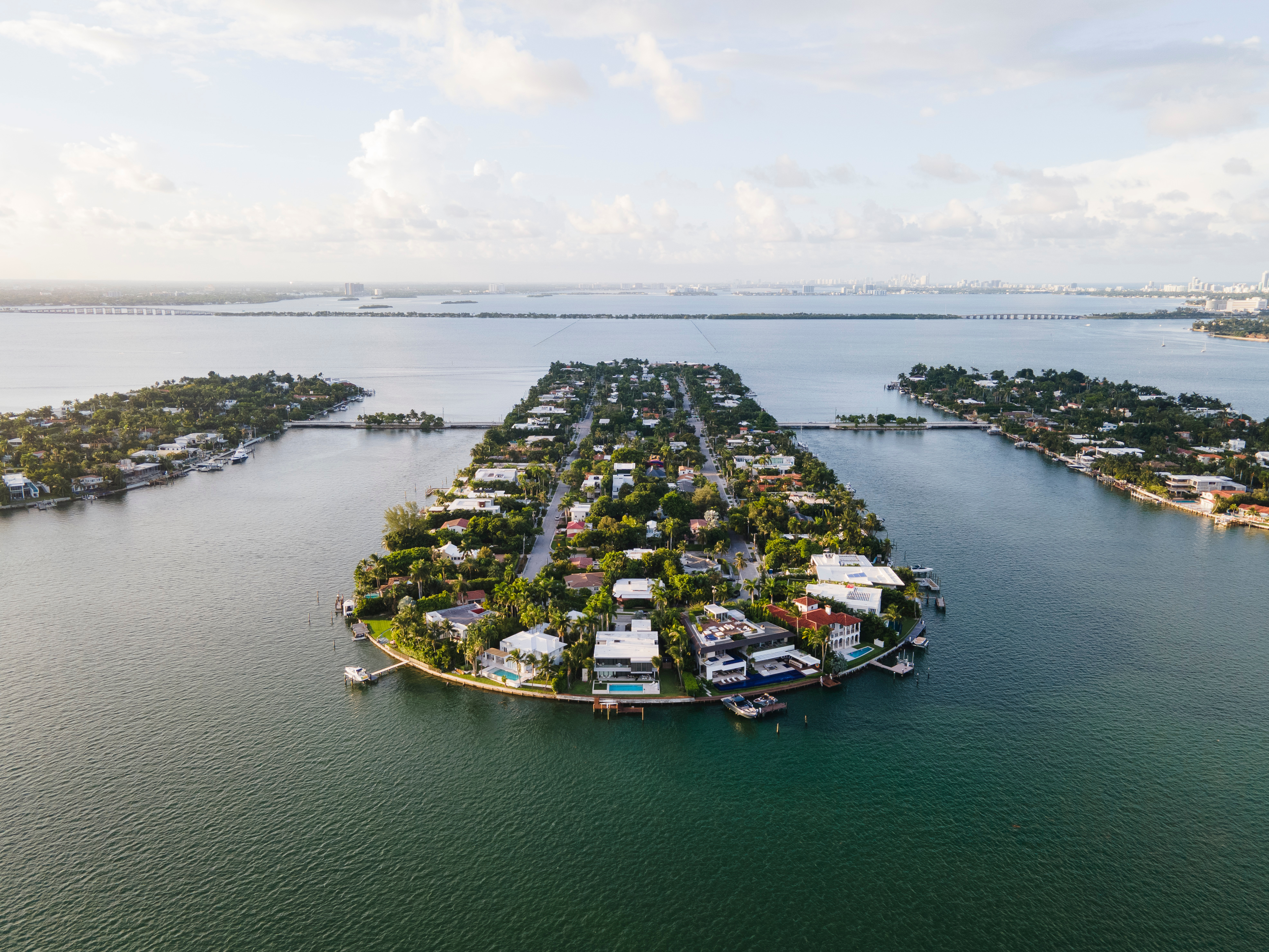
The Venetian Islands are a chain of six islands strung across Biscayne Bay between mainland Miami and Miami Beach, linked by the 2.5-mile Venetian Causeway that opened in 1926. From west to east: Biscayne Island, San Marco Island, San Marino Island, Di Lido Island, Rivo Alto Island, and Belle Isle. The chain also splits jurisdictionally -- Biscayne and San Marco sit inside the City of Miami, while San Marino, Di Lido, Rivo Alto, and Belle Isle sit inside the City of Miami Beach.
The key thing to understand before you shop the chain: only one island is a condo market. Four of the six -- San Marco, San Marino, Di Lido, Rivo Alto -- are pure single-family-home enclaves with no condominium inventory. Biscayne Island is mostly SFH but carries one condo tower (1000 Venetian Way). Belle Isle, the easternmost island and the closest to South Beach, is the condo island. This is the homes-vs-condos companion to our full Venetian Islands condo comparison and our broader Miami Beach luxury-islands overview.
The 6-Island Chain at a Glance
| Island | City | Type | Condo Buildings | Typical Lot / Unit Feature |
|---|---|---|---|---|
| Biscayne Island | Miami | SFH + one condo tower | 1000 Venetian Way | Larger estate lots; toll plaza sits here |
| San Marco Island | Miami | SFH only | 0 | Smallest island by home count; ~60 estates |
| San Marino Island | Miami Beach | SFH only | 0 | East/West split; site of the 2025 $46M sale |
| Di Lido Island | Miami Beach | SFH only | 0 | Largest island in the chain by land area |
| Rivo Alto Island | Miami Beach | SFH only | 0 | East/West split; Real World Miami filming site |
| Belle Isle | Miami Beach | Condo island | 7 (plus Standard Spa hotel) | Only Venetian Island with multifamily density |
Waterfront lots on the four SFH-only islands (and dry lots on Biscayne) are cut to a common Venetian Islands standard: waterfront ~10,500 SF (60 ft wide by 175 ft deep), dry lot ~7,500 SF. Individual lots vary above and below those figures.
How the Islands Were Built
The Venetian Islands were dredged into being during Florida's 1920s land boom. The Biscayne Bay Improvement Company platted Rivo Alto first in February 1922, then Di Lido in January 1923, then San Marco and San Marino jointly in June 1923; Biscayne Island came online in the same window. Crews pulled sand from the bottom of Biscayne Bay and pumped it into forms. Belle Isle is the exception: it was a naturally occurring mangrove hammock -- originally "Bull Island" or "Bulls Island" -- that was cleared, reshaped, and expanded with dredged sand around it. It is the only Venetian Island with a natural origin.
The Venetian Causeway itself replaced John Collins's 1913 wooden Collins Bridge, the original Miami-to-Miami-Beach link that Carl Fisher had helped finance a decade earlier. Fisher's dredge fleet -- the same fleet that built up the barrier island and Star, Palm, and Hibiscus -- worked in parallel on the Venetian chain. Engineer Harvey Stanley and the Raymond Concrete Pile Company of New York built the causeway, which opened on February 28, 1926: 2.5 miles of reinforced concrete viaducts on more than 84,000 linear feet of piling, twelve bridges (ten fixed spans, two bascule drawbridges), geometric concrete guardrails, and octagonal entrance towers. It was added to the National Register of Historic Places in 1989. A major FDOT bridge rehabilitation and drawbridge replacement ran between 1996 and 1999.
Why the Islands Split Between Homes and Condos
The 1920s plat and the mid-century zoning that followed are what determine what you can buy today. Rivo Alto, Di Lido, San Marino, San Marco, and Biscayne were carved into single-family lots at that Venetian standard (60-by-175 waterfront, 75-by-100 dry), and Miami Beach's RS single-family districts and the City of Miami's equivalent zoning preserved that character. Nothing multifamily got built on those five.
Belle Isle went the other way. As the only pre-existing island in the chain, its footprint was already larger and its lot pattern less rigid. Miami Beach zoned it under the RM (residential multifamily) framework, and starting in 1958 with Belle Towers, developers built a run of mid-rise and high-rise residential buildings up Island Avenue. Today Belle Isle holds seven condominiums, one cooperative, the Standard Spa hotel, Belle Isle Park, and a handful of low-rise Farrey Lane parcels. The one condominium exception outside Belle Isle is 1000 Venetian Way on Biscayne Island, delivered in 1983 on a parcel consolidated for higher-density use, and it remains the only condo project on any of the five SFH-dominant islands.
Biscayne Island
Character. The westernmost island in the chain, closer to Edgewater and downtown Miami than to Miami Beach -- functionally the mainland end of the causeway and the first island you cross onto after leaving the toll plaza. Fastest access from any Venetian Island to the Arsht Center, Perez Art Museum, Frost Science, Wynwood, and the Design District.
Homes vs condos. Almost entirely single-family estates, plus 1000 Venetian Way -- the 22-story bayfront tower with ten four-story townhomes on the north side of the island. This is the only condo address on any of the five SFH-dominant islands and the westernmost Venetian Islands condo you can buy.
Lot sizes and trades. Waterfront lots follow the ~10,500-SF standard with some larger parcels; dry lots run the standard ~7,500 SF. Waterfront home trades on Biscayne generally sit in the mid-seven to low-eight-figure range depending on renovation and dockage.
Notable feature. The Venetian Causeway toll plaza sits at 800 Venetian Way on Biscayne Island, so every Miami-to-Beach crossing on the causeway physically passes through the island.
San Marco Island
Character. The second-westernmost island, sitting between Biscayne and San Marino inside the City of Miami. Various listings describe it as the smallest and most tightly held of the Venetian Islands by home count (often cited at roughly 60 or so estates), which produces very thin resale flow and unusually stable ownership.
Homes vs condos. Single-family only. No condominium inventory. Zoned and platted as a pure SFH island since the 1920s.
Lot sizes and trades. Standard Venetian lot dimensions -- ~10,500 SF waterfront, ~7,500 SF dry. Recent published listing bands typically run from the low $2M range for interior homes up to $12M and above for finished waterfront estates.
Access considerations. San Marco has no formal guard gate. It reads as private mostly by virtue of small size and low turnover, not gated infrastructure.

San Marino Island
Character. Sits between San Marco and Di Lido, split by the causeway into East and West San Marino. It carries some of the higher-end architectural stock on the chain -- Mediterranean Revival, mid-century, and contemporary teardown-rebuilds -- and it is the first island east of the mainland to sit inside the Miami Beach city limits.
Homes vs condos. Single-family only. Zero condominium inventory.
Lot sizes and trades. Standard Venetian lot pattern. Published listing bands run from roughly $1.35M for interior tear-down parcels up to $23M-plus for finished waterfront estates. The July 2025 sale of 55 East San Marino Drive at $46 million reset the top of the Venetian Islands comp sheet and remains the highest recorded residential trade on the chain.
Di Lido Island
Character. The largest Venetian Island by land area, split by the causeway into East and West Di Lido. Wider mix of home styles than the other SFH islands -- older mid-century Mediterranean stock, contemporary rebuilds, and a handful of homes with architectural pedigree.
Homes vs condos. Single-family only. No condominium buildings.
Lot sizes and trades. Standard Venetian lot dimensions; because Di Lido is the biggest island by land, it holds more inventory than the other SFH islands. Published listing bands run from roughly $1.65M for interior stock up to $18.75M for finished waterfront estates.
Notable feature. The southwest tip carries some of the best downtown-skyline sunset exposures on the chain. Long stretches of interior blocks on both East and West Di Lido trade at meaningfully lower per-foot pricing than the waterfront.
Rivo Alto Island
Character. The second-easternmost island, sitting between Di Lido and Belle Isle, also split by the causeway into East and West Rivo Alto. Typically the quietest of the five SFH islands -- long-time owners, renovation activity rather than teardown volume, thinner flip trades than the western islands.
Homes vs condos. Single-family only.
Lot sizes and trades. Standard Venetian lot dimensions -- 10,500-SF waterfront, 7,500-SF dry. Published listings run from roughly $2.15M for interior stock up to $29M-plus for finished waterfront estates.
Notable feature. The house MTV used for the second season of The Real World in 1996 was on East Rivo Alto Drive (often mis-attributed to Di Lido in older writeups). Rivo Alto is also the closest SFH island to Belle Isle, Sunset Harbour, and the South Beach commercial corridor.
Belle Isle
Character. The easternmost island in the chain, smallest by land area, and the only Venetian Island with meaningful multifamily density. Directly across a short bridge from Sunset Harbour and roughly a 10- to 15-minute walk from Lincoln Road in South Beach. Also the only Venetian Island that existed before the 1920s dredging -- Bull Island cleared, reshaped, and expanded around a natural mangrove hammock.
Homes vs condos. The condo island. Seven condominium buildings and one cooperative sit on Island Avenue and 10 Venetian Way, plus the Standard Spa hotel at 40 Island Avenue and Belle Isle Park at the center of the island. A handful of low-rise Farrey Lane parcels are the SFH exceptions; single-family inventory here is minimal compared to the other five islands.
Buildings that anchor the market. The two recognizable trophies are Grand Venetian (2002, 25 stories, newest on the chain) and Nine Island Avenue (1981, 216 units, deepest amenity stack). Legacy inventory at Belle Plaza, Belle Towers, Costa Brava, Island Terrace, and Terrace Towers holds the pre-1980 mid-rise pricing tier. The Belle Isle condo guide walks every building.
Notable features. Belle Isle Park runs down the center of the island with two dog runs, a shaded playground, tennis, and a perimeter walking path. The Standard Spa opened in 2005 in the former Norman Giller-designed Monterrey Motel and Yacht Club (1953, later the Lido Spa). Across the small bridge east sit Maurice Gibb Memorial Park (reopened April 2025 after a $12.1M renovation), Publix on West Avenue, and the Sunset Harbour Yacht Club.
Buying a Home vs a Condo on the Chain
If you're deciding between an SFH on one of the estate islands and a condo on Belle Isle, the trade-off comes down to three axes.
Ownership scale. Waterfront homes on Biscayne, San Marco, San Marino, Di Lido, and Rivo Alto sit on ~10,500-SF lots with 60 feet of water frontage and generally 3,500 to 8,000-plus SF of interior building. A Belle Isle condo residence is typically 600 to 3,000 SF of interior with balcony exposure. If yard, dock, pool, and building volume matter, the SFH islands win. If lock-and-leave living with full-service programming matters, Belle Isle wins.
Walkability. Belle Isle is the only Venetian Island with walkable retail nearby (Sunset Harbour is a three-to-five-minute walk across the bridge). The five SFH islands are car-dependent for anything beyond a causeway run.
Control and rules. SFH ownership on the five estate islands is unencumbered by an HOA -- Miami Beach and City of Miami zoning are the only overlays, and there are no private community rules or private board approvals. On Belle Isle, condo boards, HOA fees, and building-specific bylaws govern renovation and rental. Short-term rentals are heavily restricted across all six islands regardless of ownership type.
For the full condo-side breakdown, see the Venetian Islands condominium guide. Buyers cross-shopping against Star, Palm and Hibiscus, Sunset, and Fisher should read the Miami Beach luxury-islands buyer's guide.
The Causeway, the Toll, and Getting Around
The causeway is the address. Every one of the six islands is only reachable via the Venetian Causeway. There is no through route from Miami Beach's main grid onto the SFH islands; the causeway is the only vehicular path. That connectivity is the entire personality of the chain: unlike the guard-gated single-bridge islands (Star, Palm, Hibiscus, and the Sunset Islands), the Venetian Islands are integrated into the daily bay-corridor commute. None of the six islands has a private guard gate.
The toll plaza sits on Biscayne Island. The plaza is at 800 Venetian Way at the mainland side, and every vehicle crossing between Miami and Miami Beach on the causeway passes through it. Passenger cars pay $3.25 per crossing under the toll structure that took effect October 1, 2025 (SunPass rate), with a Toll-By-Plate rate slightly higher and a monthly administrative fee for plate customers. Two annual plans matter for anyone considering the chain:
- Venetian Causeway Property Owner Plan. Free for causeway property owners and their children under 23 who live with the owner. Unlimited crossings, valid October to September annually. This applies to owners on any of the six islands, plus adjacent causeway-parcel owners.
- Commuter Plan. Approximately $120 per year, available to Venetian Islands residents (renters, not owners), causeway employees, and Sunset Harbour residents on the Miami Beach side.
Both plans are administered by Miami-Dade's Department of Transportation and Public Works (DTPW).
Biking and walking. The causeway has dedicated bike-and-pedestrian lanes running its full 2.5-mile length across all twelve bridges, and it is one of the most-used running and cycling routes in Greater Miami. Cyclists and pedestrians pay no toll.
Getting around. Belle Isle is the only Venetian Island where car-optional living is realistic thanks to the Sunset Harbour bridge. The five SFH islands are car-required for anything beyond the causeway itself.
FAQ
How many Venetian Islands are there and where are they? Six -- Biscayne, San Marco, San Marino, Di Lido, Rivo Alto, and Belle Isle -- all in Biscayne Bay between mainland Miami and Miami Beach, linked by the 2.5-mile Venetian Causeway that opened in 1926. Biscayne and San Marco sit inside the City of Miami; San Marino, Di Lido, Rivo Alto, and Belle Isle sit inside the City of Miami Beach.
Which Venetian Islands have condos and which are single-family only? Belle Isle is the only island with meaningful condo inventory -- seven condominium buildings and one cooperative. Biscayne Island has one condo tower, 1000 Venetian Way. San Marco, San Marino, Di Lido, and Rivo Alto are single-family-home only, with no condominium buildings.
Which Venetian Island is the largest? Di Lido Island is the largest by land area. Belle Isle is the smallest by land area but the densest by residential population, because of its condominium buildings.
Are any of the Venetian Islands gated? No. None of the six Venetian Islands has a private guard gate. The Venetian Causeway is a public through-road connecting Miami and Miami Beach, and all six islands sit along it without gated entry. This is one of the main lifestyle differences between the Venetian chain and the guard-gated single-family islands (Star, Palm, Hibiscus, Sunset Islands, La Gorce, Allison, Indian Creek).
Which island is closest to South Beach and which is closest to downtown Miami? Belle Isle is the easternmost island in the chain and sits at the doorstep of South Beach and Sunset Harbour. Biscayne Island is the westernmost and is closest to Edgewater and downtown Miami. The toll plaza sits on Biscayne Island at 800 Venetian Way.
Where do the Venetian Islands rank on price compared to Star, Palm, and Hibiscus? The Venetian Islands are the most connected and walkable of Miami Beach's luxury islands, but not the most expensive. Star Island is a nine-figure market at the top and eight-figure minimum on the low end. Palm Island's median listing is in the $30M-plus range. Venetian Islands SFH trades are broadly $2M for interior tear-downs up to the mid-teens for waterfront estates, with recent record trades reaching $46M in 2025. Belle Isle condos trade well below the SFH-island bands. The full luxury-islands comparison walks the price tiers.
What is the oldest Venetian Islands condo building? Belle Towers at 16 Island Avenue, delivered in 1958. It is also the smallest of the Belle Isle condo buildings at 46 units.
Do you pay a toll to drive onto the Venetian Islands? Yes if you're not a resident or owner. The Venetian Causeway toll plaza sits on Biscayne Island. The SunPass rate is $3.25 per crossing under the October 2025 structure. Owners on the causeway (all six islands and adjacent parcels) qualify for the free Property Owner Plan; renters and eligible residents can use the ~$120-per-year Commuter Plan. Cyclists and pedestrians cross for free.
How To Use This Guide
Start with the shape of ownership: house on a 10,500-SF waterfront lot, or condominium on Belle Isle. If it's a house, the choice among Biscayne, San Marco, San Marino, Di Lido, and Rivo Alto comes down to which side of the causeway (Miami vs Miami Beach), which end of the chain (mainland-close vs beach-close), and which waterfront exposure -- downtown, bay interior, or open bay -- is in inventory. If it's a condo, work the Venetian Islands condominium guide and pick on the era question first, then the building.
We track resale activity, HOA changes, and recent comps across the entire chain continuously. For a custom comp set on a specific island, block, or building, reach out.
Related Reading
- Venetian Islands Condos Guide -- All 8 Belle Isle Buildings Compared
- Miami Beach Luxury Islands Buyer's Guide
- Fisher Island Buildings Compared
- Sunset Harbour Miami Beach Guide
This guide is for informational purposes and does not constitute a solicitation or offer to buy or sell real estate. Lot dimensions, unit counts, price bands, and toll rates are compiled from public records, condominium and building material, and Miami-Dade public reporting, and may change over time. Prospective buyers should verify current specifications, zoning, HOA dues, and toll structure directly with the relevant municipality (City of Miami or City of Miami Beach), the building association, and Miami-Dade DTPW before making purchase decisions.
Condo buildings in Venetian Islands
Photos, floor plans, amenities, and current units for sale and rent in each.
- 1000 Venetian Way
- Belle Plaza
- Belle Towers
- Costa Brava
- Grand Venetian
- Island Terrace at 5 Island Ave
- Nine Island Avenue
- Terrace Towers at 3 Island Ave
Tags
Related Articles
Venetian Islands Miami Condos: Every Belle Isle Building Compared (2026)
The Venetian Islands are six man-made islands between Miami and Miami Beach, but almost every condo sits on one of them: Belle Isle. Here are all eight Venetian Islands condominium buildings compared -- year built, units, architect, and which building fits which buyer.
Bal Harbour Miami Guide (2026): Lifestyle, Condos, Bal Harbour Shops, Restaurants, and Things To Do
A research-backed guide to Bal Harbour, Miami's smallest village and one of South Florida's most exclusive oceanfront enclaves. Major condos, Bal Harbour Shops, Le Zoo, Hillstone, and what makes Bal Harbour different from Sunny Isles and Surfside.
South of Fifth Miami Beach Guide (2026): Lifestyle, Condos, Restaurants, Parks, and Things To Do
A research-backed guide to South of Fifth (SoFi) - the southernmost slice of South Beach. The major condo buildings, Joe's Stone Crab and Prime 112, South Pointe Park, and what makes SoFi the most coveted Miami Beach submarket.