Florida Amendment 3 Passed: What the $250,000 Homestead Exemption Means for Miami Real Estate
Florida voters approved Amendment 3 on November 3, 2026. Here is what changes in 2027 and 2028, who saves and who doesn't, what our listing data shows about Miami condos, and the December 31, 2026 residency deadline that matters most for people moving here.


Florida voters approved Amendment 3 on November 3, 2026, with about 62% of the vote in unofficial returns. It needed 60%.
The short version: if you own and live in your Florida home, your city, county and special-district taxes drop in 2027 and drop again in 2028. If you own a rental, a second home or a commercial property, you get a smaller benefit: a tighter cap on how fast your taxable value can rise. If you move to Florida after this year, you wait until your fifth year of homestead before you get the full break.
Below is what the amendment actually says, what it saves in real dollars, what our listing data shows about who owns Miami's condos, and our take on what it means for buyers, sellers and investors.
What Amendment 3 changes
The amendment rewrites three parts of the Florida Constitution. Everything takes effect January 1, 2027.
| Change | Before | After |
|---|---|---|
| Homestead exemption, non-school taxes | About $51,000 | $150,000 in 2027, $250,000 in 2028, then indexed to inflation from 2029 |
| Homestead exemption, school taxes | $25,000 | $25,000 (unchanged) |
| New residents after December 31, 2026 | Same as everyone | About $50,000 non-school exemption for the first four years; the full exemption from the fifth year |
| Annual assessment cap on non-homestead property | 10% | 5% |
| Save Our Homes cap on homesteads | 3% or CPI, whichever is lower | Unchanged |
| Portability when you move between Florida homesteads | Up to $500,000 | Unchanged |
| How counties and cities can spend property taxes | Broad | Limited to listed core uses |
A few details matter more than the headlines suggest.
It is an exemption on assessed value, not on market value. A homestead you have owned for years is often assessed well below what it would sell for, because Save Our Homes holds increases to 3% a year. If your assessed value is under $250,000, the new exemption can wipe out your non-school property taxes entirely from 2028. You would still pay school taxes and any non-ad valorem charges such as solid waste or special assessments.
School taxes are untouched. School district levies are roughly 6.6 mills in Miami-Dade, and the school exemption stays at $25,000. That is why no one's bill goes to zero.
The 5% cap covers condos, single-family homes, small rentals and commercial property that are not homesteaded. It applies to non-school taxes only, and it resets when a property sells. A buyer of a non-homestead condo is still assessed at full value the year after closing, then capped at 5% a year from there.
Local governments can go further. The amendment lets counties and cities raise the exemption for their own levies, and special districts can do it by referendum. It also lets counties and cities shorten the five-year wait for newcomers starting in 2030, by a two-thirds vote, if they find a critical local need.
How much homeowners save
The savings depend on two things: how much of your assessed value is newly exempt, and your non-school millage rate. Millage is dollars of tax per $1,000 of taxable value.
A useful rule of thumb: once the $250,000 exemption is in place, every mill of non-school tax rate is worth about $200 a year to a homestead assessed at $250,000 or more. In 2027 it is about $100 per mill.
Here is the math for a homestead in the City of Miami, using the 2025 rates published by the Miami-Dade Property Appraiser.
| Non-school levy, City of Miami | Mills |
|---|---|
| Miami-Dade County countywide operating | 4.574 |
| County library district | 0.281 |
| County debt service | 0.417 |
| City of Miami operating | 7.108 |
| City of Miami debt service | 0.254 |
| Regional water and navigation districts | 0.257 |
| The Children's Trust | 0.464 |
| Total non-school | 13.35 |
| Homestead assessed at $250,000 or more, City of Miami | Newly exempt value | Estimated savings per year |
|---|---|---|
| 2027 ($150,000 exemption) | About $99,000 | About $1,320 |
| 2028 ($250,000 exemption) | About $199,000 | About $2,650 |
These are estimates at current rates. Your actual savings will depend on your assessed value and on the millage your city and county adopt for 2027 and 2028. A homestead in a city with lower municipal rates, such as Aventura, saves less in dollars because there is less non-school tax to exempt.
For context, Miami-Dade County estimates it will collect about $386 million less in its first budget year under the amendment and about $697 million less per year once the $250,000 exemption is fully in place. Statewide, the state's Revenue Estimating Conference put the local revenue loss at roughly $5 billion in the first year, growing to around $12 billion a year at full implementation.
What our data shows about Miami condos
Here is the part most coverage misses. Amendment 3's big cut only goes to homesteads, and a large share of South Florida's condos are not homesteaded. They are owned by investors, second-home buyers and people who live somewhere else.
We looked at every active for-sale listing on the MLS in Miami-Dade, Broward and Palm Beach counties as of November 5, 2026. Many listings report whether the current tax bill reflects a homestead exemption. Among the condo listings that report it:
| County | Condo listings reporting status | Share with a homestead exemption | Median tax bill as a share of list price, homestead | Median tax bill as a share of list price, no homestead |
|---|---|---|---|---|
| Miami-Dade | 3,036 | 50% | 0.86% | 1.37% |
| Broward | 1,478 | 52% | 1.13% | 1.83% |
| Palm Beach | 1,019 | 56% | 0.86% | 1.35% |
By comparison, 78% of the single-family homes for sale in the three counties that report their status carry a homestead exemption.
The split varies a lot by neighborhood.
| Neighborhood | Condo listings reporting status | Share with a homestead exemption |
|---|---|---|
| Downtown Miami | 149 | 30% |
| Hollywood Beach | 146 | 34% |
| Palm Beach | 77 | 34% |
| West Palm Beach | 87 | 38% |
| Edgewater | 112 | 38% |
| Sunny Isles Beach | 256 | 39% |
| South Beach | 186 | 40% |
| Brickell | 240 | 40% |
| Mid-Beach | 136 | 49% |
| Fort Lauderdale | 409 | 53% |
| Aventura | 345 | 57% |
| Boca Raton | 386 | 60% |
| Delray Beach | 263 | 62% |
| Coral Gables | 78 | 63% |
| Hialeah | 114 | 68% |
Two takeaways.
In Downtown Miami, Brickell, Edgewater, Sunny Isles and South Beach, six to seven in ten condos for sale are not homesteaded. For those owners, Amendment 3 means a 5% cap instead of 10%, and nothing more. The towers where Amendment 3 changes ownership costs the most are the ones full-time residents live in.
The tax bill on a listing tells you about the seller, not about you. In Miami-Dade, the median homesteaded condo listing shows a tax bill of 0.86% of its asking price, against 1.37% for listings without a homestead. On a $500,000 condo that is the difference between roughly $4,300 and $6,850 a year. Amendment 3 widens that gap. After 2028, a long-time homesteaded seller's bill will understate what an investor or second-home buyer pays by even more. Budget from the property's market value and your own status, not from the seller's bill.

The December 31, 2026 deadline
This is the most time-sensitive part of the amendment.
The full exemption goes to people who maintained a permanent residence in Florida as of December 31, 2026. The test is residency, not when you buy. A Florida resident who buys their first home in 2028 still qualifies for the full $250,000 exemption.
People who become Florida residents on or after January 1, 2027 get the old exemption of about $50,000 for their first four years of homestead and the full exemption starting in their fifth year.
In the City of Miami, that wait costs a homestead assessed at $250,000 or more about $2,650 a year at current rates, or roughly $10,000 over four years.
If you are relocating to South Florida, the practical question is whether you can make Florida your permanent home before the year ends. Property appraisers typically look at evidence such as a Florida driver's license, voter registration, vehicle registration, a recorded declaration of domicile and where you file your taxes. The residence has to be real. This is a decision to make with a Florida attorney or tax adviser, not on a deadline alone.
One more thing to know: the five-year rule may be challenged in court. In 1985, the U.S. Supreme Court struck down a New Mexico property tax exemption that was limited to veterans who lived in the state before a fixed date. Florida's rule is different in its details, but the comparison will come up. We would plan as if the rule applies.
For the rest of the move, our Miami relocation guide and our guide for foreign buyers cover the basics.
What it means for buyers, sellers and investors
Owner-occupant buyers. Lower carrying costs mean a little more room in your budget. About $2,650 a year is roughly $220 a month. At a 6.5% 30-year mortgage rate, that monthly amount would cover the payment on about $35,000 of additional loan. It matters at the margin. It does not change what you can afford by much.
Sellers of homesteaded homes. Your own bill gets smaller, and portability still lets you carry up to $500,000 of Save Our Homes savings to your next Florida homestead. The new exemption applies to your next home too, so the amendment does not add a new reason to stay put.
Condo investors and second-home owners. The 5% cap slows the growth of your taxable value while you own the unit. It does not help the year after you buy, when the unit is assessed at full value. School taxes are still uncapped for non-homestead property. Underwrite rental condos at full value and today's millage, and treat the 5% cap as upside in later years.
Renters. There is no direct relief. The constitution allows the Legislature to give renters a property tax break, but it does not require one and none has been passed.
Pre-construction buyers. If you are buying a new condo that closes in 2027 or later and you plan to live in it, your homestead status will depend on residency, not on the closing date. If you plan to rent it out, plan around the 5% cap rather than the exemption. Our pre-construction directory lists the projects we track by area and delivery year.
What happens to local budgets
Miami-Dade County lists fire rescue, libraries, parks, transit, roads, bridges and flood protection among the services property taxes currently fund. The amendment now limits how counties and cities can use property tax revenue to listed purposes, including public safety, schools, infrastructure, flood control, debt and pensions, along with the operations of county and city government.
A separate law signed in June, SB 4-F, also makes it harder for local governments to raise millage. Under it, raising rates above the rolled-back rate takes a supermajority of the local board or a referendum.
Our expectation is that cities and counties will look harder at fees and special assessments, which the homestead exemption does not cover, and at service cuts. Watch your August 2027 TRIM notice, the proposed tax notice the property appraiser mails each summer. It will be the first one to show the new exemption.
Our take
Amendment 3 is a real tax cut for the people who live here full time. A Miami homeowner saving $2,000 to $3,000 a year will notice it, and owners with lower assessed values may see their non-school taxes disappear.
It is not a big change for much of the Miami condo market. In the condo-heavy neighborhoods where investors and second-home owners make up most of the sellers, ownership costs barely move. Asking prices there will still be set by rents, insurance, association fees and supply, not by this amendment.
The part we like least is the five-year rule. Miami's market has been built by people moving here. Charging newcomers more for four years works against that, and it may not survive a court challenge. If you are planning a move, our advice is simple: if you can genuinely make Florida your home before December 31, 2026, do it.
If you want to see what Amendment 3 means for a specific home or condo, contact our team. We can pull the assessed value, the millage and the current tax bill, and show you what you would actually pay. If you are thinking about selling, start with our seller guide.
How we built the data
The condo and single-family figures come from active for-sale listings on the South Florida MLS in Miami-Dade, Broward and Palm Beach counties as of November 5, 2026. The share with a homestead exemption counts only listings that report whether their tax bill reflects one: 5,533 of 17,840 condo listings across the three counties. Listing agents report this field voluntarily, so treat the shares as an indication rather than a census. Tax bills as a share of list price use listings with a 2025 or 2026 tax year.
City of Miami savings use the 2025 millage rates published by the Miami-Dade Property Appraiser, an assumed 2026 non-school exemption of about $51,000, and a homestead assessed at $250,000 or more. Amendment provisions come from the text of the joint resolution the Legislature placed on the ballot, CS/HJR 1-F. Revenue estimates come from Miami-Dade County and the state's Revenue Estimating Conference.
This article is general information, not tax or legal advice.
Frequently asked questions
What is Florida Amendment 3?
Amendment 3 is the 2026 Florida constitutional amendment titled "Save Our Homes From Excessive Property Taxes." It raises the homestead exemption for non-school property taxes to $150,000 in 2027 and $250,000 in 2028, cuts the annual assessment cap on non-homestead property from 10% to 5%, limits how counties and cities can spend property tax revenue, and gives people who become Florida residents after December 31, 2026 the full exemption only from their fifth year of homestead. Voters approved it on November 3, 2026.
When does Amendment 3 take effect?
January 1, 2027. The $150,000 exemption applies to the 2027 tax year, and the $250,000 exemption applies from the 2028 tax year. The amount is adjusted for inflation starting in 2029.
Do I need to reapply for my homestead exemption?
Owners who already have a homestead exemption keep it, and the larger amount is expected to apply automatically. Confirm with your county property appraiser, especially if anything about your ownership or residency has changed.
Does Amendment 3 lower school property taxes?
No. The school tax exemption stays at $25,000. School levies are about 6.6 mills in Miami-Dade, so every homestead still pays school taxes.
How much will I save under Amendment 3?
Once the $250,000 exemption is in place, each mill of non-school tax is worth about $200 a year to a homestead assessed at $250,000 or more. In the City of Miami, with about 13.35 mills of non-school tax, that is roughly $1,320 in 2027 and $2,650 in 2028 at current rates.
I am moving to Florida in 2027. Do I get the $250,000 exemption?
Not right away. If you were not a Florida resident on December 31, 2026, you get about $50,000 of non-school exemption for your first four years of homestead and the full exemption beginning in your fifth year. Starting in 2030, a county or city can vote by a two-thirds majority to shorten that wait.
I already live in Florida but don't own a home yet. Do I have to buy before December 31, 2026?
No. The test in the amendment is whether you maintained a permanent residence in Florida as of December 31, 2026, not whether you owned a home then. A resident who buys later still qualifies for the full exemption.
Does Amendment 3 help condo investors and second-home owners?
Only modestly. Non-homestead property gets a 5% annual cap on assessment increases for non-school taxes instead of 10%. The cap resets when the property sells, so a new buyer is assessed at full value first.
Does Amendment 3 help renters?
Not directly. The constitution allows the Legislature to provide property tax relief to renters who are permanent residents, but it does not require it.
Keep reading
- Browse condos and homes for sale in South Florida.
- Compare HOA fees by building in Miami.
- Explore Miami neighborhoods and their condo markets.
- Talk to our team about what Amendment 3 means for a specific property.
Tags
Born and raised in Miami, Kyle Benjamin combines a background at Blackstone and Oppenheimer & Co. with hands-on coding and financial analysis. He founded REHUB Miami to make South Florida real estate easier to research through building comparisons, market data, floor plans, and local insights.
Read Kyle’s full bioRelated Articles

The Fed's Rate Cut and South Florida Real Estate
On December 10, 2025, the Federal Reserve cut its benchmark interest rate by 0.25%, marking the third reduction this year. What does this mean for South Florida buyers, sellers, and investors?
Faena Residences Miami Closes an $817 Million Construction Loan, the Largest in Florida History
Fortune International Group and KAR Properties closed an $817 million construction loan from Tyko Capital for Faena Residences Miami, the twin 68-story towers on the Miami River. Here is how the record was set, what it means for buyers and deposits, and how Faena's pricing compares with the neighborhood around it.
Is Pre-Construction in Miami a Good Investment? What the Numbers Show (2026)
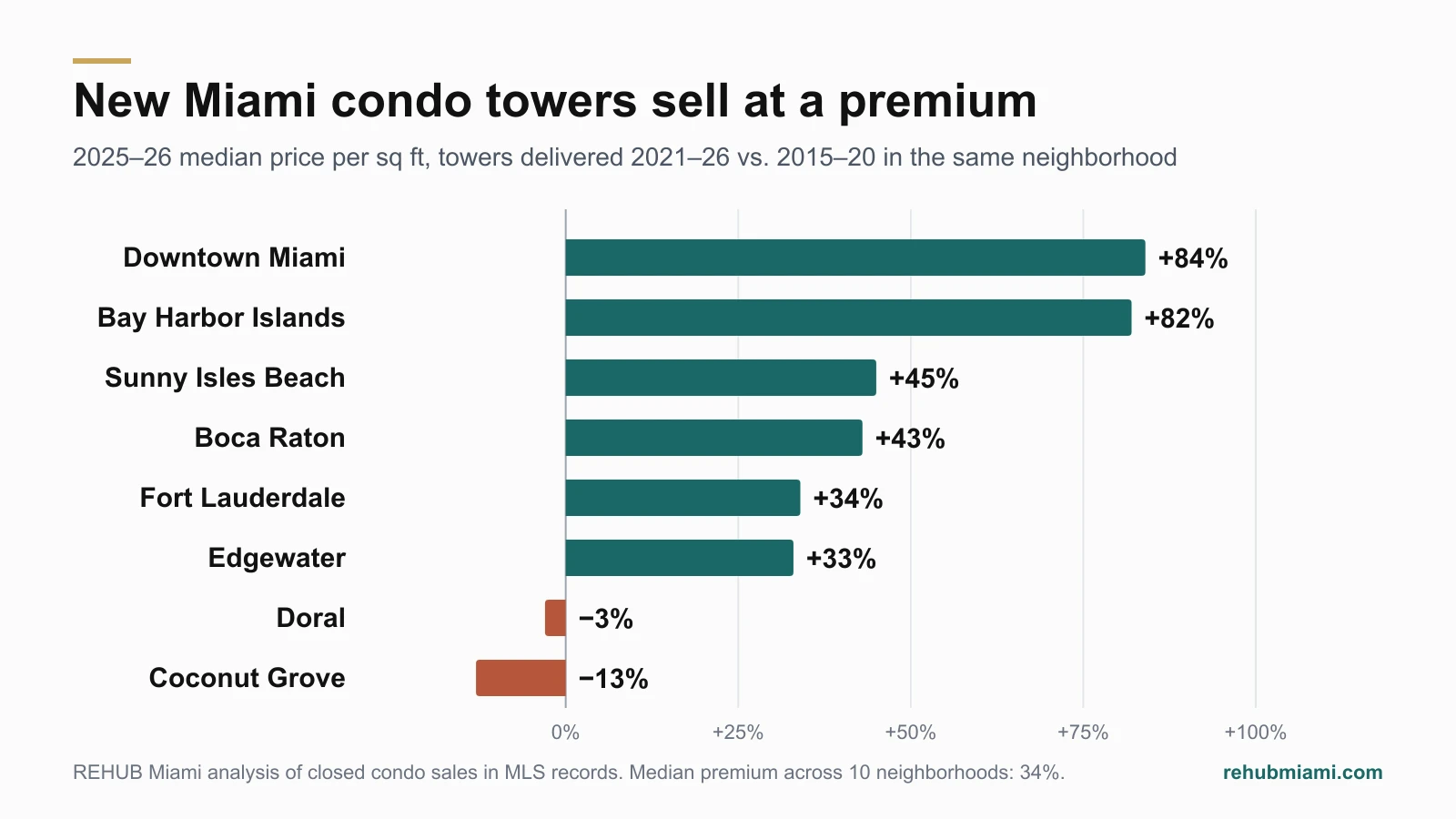
Brand-new Miami condo towers sold for a median 34% more per square foot in 2025–26 than towers built just five to ten years earlier in the same neighborhood. That newness premium is what a pre-construction buyer is positioned to capture, and our analysis of 41,000 sales shows it fades after delivery. Here is when pre-construction pays, what a deposit really earns, and the risks to weigh.