Is Pre-Construction in Miami a Good Investment? What the Numbers Show (2026)
Brand-new Miami condo towers sold for a median 34% more per square foot in 2025–26 than towers built just five to ten years earlier in the same neighborhood. That newness premium is what a pre-construction buyer is positioned to capture, and our analysis of 41,000 sales shows it fades after delivery. Here is when pre-construction pays, what a deposit really earns, and the risks to weigh.

Is Pre-Construction in Miami a Good Investment? What the Numbers Show
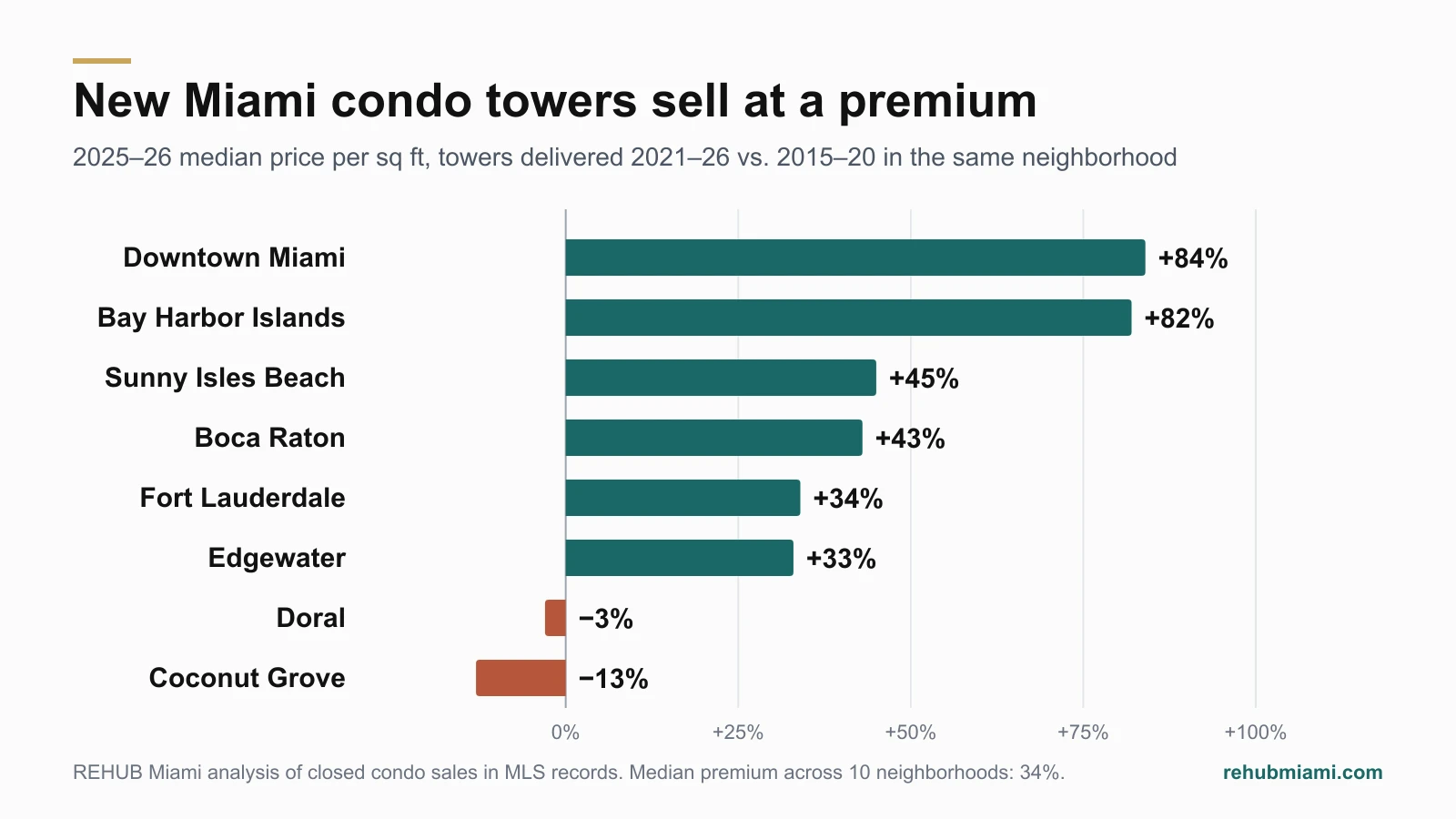
Short answer: yes, when you buy early, at launch pricing, in the right location. Miami buyers pay a substantial premium for brand-new condos. In 2025 and 2026, condos in towers delivered since 2021 sold for a median 34% more per square foot than towers delivered from 2015 to 2020 in the same neighborhood, and the newer towers commanded a premium in 7 of the 10 neighborhoods we could measure. A pre-construction buyer who locks in a launch price below what finished new towers trade for is positioned to capture that premium.
Our resale data also shows the premium fades after delivery. Investors who bought resale in towers from the 2015 to 2020 wave, after those buildings were finished, gained a median 3.9% a year from 2021 to 2026, against 7.0% to 7.8% for older buildings. In practice, that means the newness premium has mostly gone to whoever owned the unit when the building was new, and when you buy matters more than almost anything else.
On this page: Key findings · The new-tower premium · Why resale buyers lagged · Timing · Building by building · What a deposit really earns · Risks · When it works · FAQ · Method
Key findings
- New towers command a premium. In 2025–26, towers delivered from 2021 to 2026 sold for a median 34% more per square foot than towers delivered from 2015 to 2020 in the same neighborhood, led by Downtown Miami (+84%), Bay Harbor Islands (+82%), Sunny Isles Beach (+45%), Boca Raton (+43%), Fort Lauderdale (+34%) and Edgewater (+33%).
- The premium fades once a building ages. Same-unit resales in towers delivered from 2015 to 2020 gained a median 3.9% a year from 2021 to 2026, against 7.0% for buildings from 2000 to 2014 and 7.8% for buildings from before 2000. The gap narrowed but did not close when we compared like with like by price range, purchase year and neighborhood.
- Timing dominated. Across all building ages, owners who bought in 2021 gained a median 11.3% a year. Owners who bought in 2023 gained 1.3% a year.
- Location and product mattered. Among 49 towers from the 2015 to 2020 wave, the change in median price per square foot from 2021–22 to 2025–26 ranged from +70% at Grove at Grand Bay to −23% at Porsche Design Tower.
- The long run has been strong. MIAMI REALTORS reported that the Miami-Dade condo median rose 94.6% from November 2015 to November 2025, from $203,000 to $395,000, although it was down 9.5% year over year in November 2025, with 14.1 months of supply.
These figures come from closed sales after each building was finished. Developer closings, the price an original pre-construction buyer paid, usually are not recorded in the MLS, so we cannot measure each original buyer's exact return. What the data does show is what finished new towers sell for and how they held value, which is the market every pre-construction buyer eventually owns into.
New towers sell at a premium
Median closed price per square foot in 2025–26, comparing towers delivered from 2021 to 2026 with towers delivered from 2015 to 2020 in the same neighborhood. Neighborhoods are listed by the number of new-tower sales.
| Neighborhood | Towers delivered 2021–26 | Towers delivered 2015–20 | New-tower premium |
|---|---|---|---|
| Downtown Miami | $1,118 (104 sales) | $608 (74 sales) | +84% |
| Edgewater | $1,006 (75 sales) | $755 (279 sales) | +33% |
| Coconut Grove | $1,610 (50 sales) | $1,841 (45 sales) | −13% |
| Fort Lauderdale | $1,148 (37 sales) | $857 (74 sales) | +34% |
| Boca Raton | $1,327 (35 sales) | $929 (10 sales) | +43% |
| Bay Harbor Islands | $1,321 (27 sales) | $726 (31 sales) | +82% |
| Doral | $383 (22 sales) | $394 (176 sales) | −3% |
| Sunny Isles Beach | $2,130 (15 sales) | $1,471 (119 sales) | +45% |
| Palm Beach Gardens | $939 (12 sales) | $1,041 (38 sales) | −10% |
| Brickell | $982 (9 sales) | $751 (314 sales) | +31% |
Part of this premium reflects the product, not only its age. Recent towers are often more heavily branded, with larger layouts, newer amenities and better sites, and neighborhoods with fewer new-tower sales, such as Brickell and Palm Beach Gardens here, swing more. The exceptions are informative too: in Coconut Grove, the established bayfront towers of the last wave, such as Two Park Grove and Grove at Grand Bay, trade above the newest buildings, and in Doral new and recent towers price about the same.
For a buyer, the practical question is simple: is the launch price you are offered well below what comparable finished new towers in that neighborhood sell for today? If it is, you are positioned to capture some of the premium. If the launch price already matches or exceeds finished new product nearby, you are paying for the premium up front.
The premium fades after delivery
The flip side of the new-tower premium is what happens once a building ages. We matched 1,854 condos that sold at least twice, at least a year apart, from 2019 to 2026.
| Building delivered | Median gain per year, same unit resold | Resold below purchase price | Lost money after ~6% selling costs | Same-building median $/sq ft, 2021–22 to 2025–26 |
|---|---|---|---|---|
| 2015–2020 (last pre-construction wave) | +3.9% (394 resales) | 23% | 39% | +12.8% (50 buildings) |
| 2000–2014 | +7.0% (795 resales) | 16% | 26% | +21.3% (100 buildings) |
| Before 2000 | +7.8% (664 resales) | 15% | 23% | +18.7% (90 buildings) |
These are mostly investors who bought after delivery, in towers that were already two to ten years old. They paid prices that still carried some of the new-building premium and saw slower growth as it wore off.
We checked whether the gap was simply a matter of comparing different kinds of condos. It narrowed but did not disappear:
- Same price range. Among units bought at $400 to $600 per square foot, the 2015 to 2020 towers gained 6.0% a year against 6.7% for 2000 to 2014 buildings and 8.9% for pre-2000 buildings. The gap was wider in the $600 to $900 range.
- Same purchase year. Among units bought in 2021, the 2015 to 2020 towers gained 8.6% a year against roughly 12% for older buildings.
- Same neighborhood. In Brickell, the largest sample, the 2015 to 2020 towers gained 6.0% a year against 6.7% for older buildings, nearly identical. Gaps were wider in Coral Gables, Aventura and Downtown Miami.
Older buildings are not automatically safer, either. Florida's post-Surfside rules require milestone inspections and fully funded structural reserves, which can mean large special assessments, and our pre-2000 group had the highest share of buildings whose prices fell from 2021–22 to 2025–26 (18%). Read our guide to Florida's milestone inspection and SIRS rules before buying in an older tower.
When you buy matters more than what you buy
The year an owner bought explained far more of the outcome than the age of the building. These are same-unit resales across all building ages:
| Year bought | Resales | Median gain per year | Resold below purchase price |
|---|---|---|---|
| 2021 | 741 | +11.3% | 3% |
| 2022 | 606 | +4.3% | 20% |
| 2023 | 262 | +1.3% | 40% |
| 2024 | 142 | +1.0% | 43% |
This is where pre-construction has a structural advantage and a structural risk. You lock in a price years before you take ownership, so buying at launch in a rising market can mean owning a finished unit worth well above your contract price. But you sell or occupy into whatever market exists at delivery, so a contract signed near a peak carries that risk until closing.

How the 2015–2020 buildings performed, building by building
Median closed price per square foot in each building, 2021–22 against 2025–26. Each building has at least five sales in both periods; buildings with fewer sales swing more from period to period.
| Building | Delivered | 2021–22 median $/sq ft | 2025–26 median $/sq ft | Change |
|---|---|---|---|---|
| Grove at Grand Bay | 2016 | $1,039 | $1,768 | +70.1% |
| Two Park Grove | 2018 | $1,330 | $2,134 | +60.5% |
| The Surf Club Four Seasons | 2017 | $3,168 | $4,451 | +40.5% |
| Three Hundred Collins | 2018 | $1,345 | $1,855 | +38.0% |
| Residences by Armani Casa | 2019 | $1,259 | $1,720 | +36.6% |
| 1010 Brickell | 2017 | $645 | $857 | +32.8% |
| Oceana Bal Harbour | 2016 | $1,914 | $2,534 | +32.4% |
| Brickell Flatiron | 2019 | $850 | $1,100 | +29.3% |
| 26 Edgewater | 2018 | $469 | $592 | +26.3% |
| Jade Signature | 2018 | $1,371 | $1,700 | +24.0% |
| One Ocean | 2016 | $1,516 | $1,853 | +22.3% |
| Dua Miami | 2016 | $620 | $756 | +22.0% |
| Turnberry Ocean Club | 2020 | $1,463 | $1,784 | +21.9% |
| Hyde Midtown | 2018 | $590 | $712 | +20.7% |
| One Paraiso | 2018 | $826 | $983 | +19.0% |
| Bay House | 2015 | $479 | $563 | +17.6% |
| The Bond on Brickell | 2016 | $628 | $737 | +17.3% |
| Parque Towers | 2019 | $688 | $803 | +16.7% |
| 5252 Paseo | 2016 | $436 | $508 | +16.3% |
| Echo Brickell | 2017 | $928 | $1,073 | +15.6% |
| Aria on the Bay | 2018 | $599 | $691 | +15.4% |
| Brickell Ten | 2016 | $491 | $566 | +15.3% |
| SLS Lux | 2018 | $690 | $795 | +15.3% |
| 1100 Millecento | 2015 | $527 | $604 | +14.6% |
| Chateau Beach Residences | 2016 | $1,078 | $1,228 | +13.9% |
| Echo Aventura | 2015 | $609 | $680 | +11.7% |
| Nine at Mary Brickell Village | 2015 | $496 | $554 | +11.6% |
| Brickell Heights East | 2017 | $688 | $766 | +11.3% |
| Merrick Manor | 2019 | $738 | $813 | +10.2% |
| Biscayne Beach | 2017 | $769 | $847 | +10.2% |
| Le Parc at Brickell | 2016 | $554 | $607 | +9.5% |
| Rise Brickell City Centre | 2016 | $674 | $738 | +9.5% |
| Muse | 2018 | $1,407 | $1,509 | +7.3% |
| Midtown Doral | 2017 | $341 | $365 | +7.2% |
| Crimson | 2016 | $525 | $560 | +6.8% |
| Icon Bay | 2015 | $606 | $644 | +6.3% |
| Paraiso Bay | 2018 | $791 | $830 | +5.0% |
| Reach Brickell City Centre | 2016 | $694 | $719 | +3.7% |
| Paraiso Bayviews | 2018 | $651 | $668 | +2.7% |
| Brickell Heights West | 2017 | $705 | $708 | +0.3% |
| Canvas | 2018 | $538 | $538 | +0.1% |
| Prive at Aventura (South) | 2017 | $1,094 | $1,088 | -0.6% |
| Gran Paraiso | 2019 | $798 | $780 | -2.2% |
| Hyde Beach House | 2019 | $719 | $680 | -5.3% |
| One Thousand Museum | 2019 | $1,478 | $1,391 | -5.9% |
| Paramount Miami Worldcenter | 2019 | $661 | $610 | -7.7% |
| Prive at Aventura | 2018 | $1,112 | $1,005 | -9.7% |
| 100 Las Olas | 2020 | $866 | $767 | -11.5% |
| Porsche Design Tower | 2016 | $1,451 | $1,116 | -23.1% |
A few patterns stand out:
- Scarce, low-density waterfront did best. The two Coconut Grove buildings, Grove at Grand Bay and Two Park Grove, led the list, in a neighborhood where new waterfront sites are rare.
- Top brands in top locations held up. The Surf Club Four Seasons, Residences by Armani Casa and Oceana Bal Harbour rose more than 30%, while Porsche Design Tower fell 23% and One Thousand Museum fell 6%.
- Large clusters mostly lagged. Three of the four towers in Edgewater's Paraiso district, Paraiso Bay, Paraiso Bayviews and Gran Paraiso, ranged from −2% to +5%; the exception, One Paraiso, rose 19%. Paramount Miami Worldcenter fell 8%. Buildings like these compete with a deep pool of similar units.
- Brickell's established towers held up. 1010 Brickell (+33%) and Brickell Flatiron (+29%) beat the group median, while Brickell Heights West was flat.
To compare current pricing across more buildings, see Miami condo price per square foot, ranked.
What a pre-construction deposit really earns
Pre-construction returns are leveraged: you control the full unit with a deposit, often 30% to 50% of the price paid in stages before closing, and pay the balance at delivery. That magnifies gains and losses on the money you put in.
Take a $1,000,000 contract with a 40% deposit ($400,000) paid over the construction period, and assume you sell soon after closing with about 6% in commissions and seller closing costs:
| Value at delivery | Price change | Selling costs (~6%) | Net result | Return on your $400,000 deposit |
|---|---|---|---|---|
| $1,200,000 | +20% | $72,000 | +$128,000 | +32% |
| $1,100,000 | +10% | $66,000 | +$34,000 | +8.5% |
| $1,000,000 | 0% | $60,000 | −$60,000 | −15% |
| $900,000 | −10% | $54,000 | −$154,000 | −38.5% |
If you keep the unit instead of selling, you pay no selling costs: at +20%, the $200,000 rise in value is equity on a $400,000 deposit, a 50% gain on paper before your own closing and carrying costs. The table leaves out those costs, financing on the remaining 60%, association fees and taxes, and what the deposit could have earned elsewhere during a three- to four-year build. Each of those lowers the result, and the same leverage works against you if values fall.
Given the new-tower premium, an outcome like the +20% row is realistic only when the launch price sits well below finished new product nearby. Our guide to buying pre-construction in Miami covers deposit schedules and contract terms in detail.
The downside: what the last bust looked like
The most recent five years were a boom followed by a cooldown. The cycle before that is a reminder of how far the downside can go.
- Prices fell about half. Miami home prices fell about 51% from their 2006 peak to November 2011, according to the S&P/Case-Shiller Miami index, which covers all residential sales.
- Supply drove the swing. Condominium completions in Miami-Dade and Palm Beach counties peaked at 16,220 units in 2007, then fell to 1,140 in 2011, according to Savills.
- Buyers who closed late carried the loss. Pre-construction contracts signed near a peak closed into a market worth far less, and buyers who could not close risked their deposits.
Today's market is structured differently: pre-construction deposit schedules now commonly run 30% to 50% of the price, and completions are not at 2007 levels. But the current signals deserve attention. MIAMI REALTORS reported 14 months of existing-condo supply in May 2025 and 14.1 months in November 2025, well past the six to nine months it calls balanced, and newer condos have been taking longer to sell than older ones.
When pre-construction makes sense, and when it doesn't
It tends to work when:
- You buy at launch, not at the end of sales. Early phases are priced below later releases, which gives you room before delivery.
- The launch price is well below finished new product nearby. Compare it with what towers delivered in the last few years sell for today, not with older resale buildings.
- The location has scarce new supply. Low-density, waterfront and established neighborhoods held value best in our data.
- You can hold three to five years after delivery. A longer hold absorbs selling costs and rides out a soft delivery year.
- The deposit schedule fits your cash. You can fund every installment without depending on a resale.
- You want the unit itself. A specific view, layout or building you would happily live in or rent is the best protection if appreciation is slow.
It tends to disappoint when:
- You are paying a launch price at or above comparable finished new towers. At that point the premium is already in the price.
- The submarket has many towers delivering at once. Each new building competes for the same resale and rental buyers.
- Your plan depends on flipping at or soon after closing. Selling costs alone can erase a small gain.
- The rental plan matters but the documents don't allow it. Check the condo declaration for minimum stays; our list of Miami condos that allow Airbnb and short-term rentals shows how often marketing and documents differ.
To compare projects that are selling now, browse Miami pre-construction condos or read how to compare Miami new developments.
Frequently Asked Questions
Is pre-construction in Miami a good investment right now?
It can be, when you buy early at a launch price well below what finished new towers sell for, in a location with limited new supply, and can hold for several years after delivery. In 2025–26, towers delivered since 2021 sold for a median 34% more per square foot than towers from 2015 to 2020 in the same neighborhood. The market has also cooled, with more than 12 months of condo supply, so compare each project's pricing carefully.
Do new condos in Miami sell for more than older ones?
Yes, in most neighborhoods. In 2025–26, condos in towers delivered from 2021 to 2026 sold for a median 34% more per square foot than towers delivered from 2015 to 2020 in the same neighborhood, with a premium in 7 of the 10 neighborhoods we measured. Coconut Grove, Doral and Palm Beach Gardens were the exceptions.
Do new condo buildings keep their value after delivery?
The new-building premium tends to fade. From 2021 to 2026, same-unit resales in towers delivered from 2015 to 2020 gained a median 3.9% a year, against 7.0% for buildings from 2000 to 2014 and 7.8% for buildings from before 2000. That favors buying before delivery at launch pricing over buying resale in a building that is a few years old.
How much deposit do you need for a Miami pre-construction condo?
Deposit schedules commonly total 30% to 50% of the purchase price, paid in installments from contract signing through construction milestones, with the balance due at closing. Because the deposit controls the full price, a 10% change in value at delivery moves the return on a 40% deposit by about 25%.
What happened to Miami pre-construction buyers in 2008?
Miami home prices fell about 51% from their 2006 peak to late 2011, according to the S&P/Case-Shiller Miami index. Buyers whose contracts closed into that market faced units worth far less than their contract price, and some forfeited deposits rather than close.
Which recent Miami towers held their value best?
Among towers delivered from 2015 to 2020 with enough sales to measure, Grove at Grand Bay (+70%), Two Park Grove (+61%), The Surf Club Four Seasons (+41%), Three Hundred Collins (+38%) and Residences by Armani Casa (+37%) saw the largest rise in median price per square foot from 2021–22 to 2025–26. Porsche Design Tower (−23%), 100 Las Olas (−12%) and one of the two Privé at Aventura towers (−10%) fell the most.
Is it better to buy pre-construction or resale in Miami?
They suit different goals. Pre-construction offers a launch price set years before delivery, a staged payment schedule and a brand-new building, which in most neighborhoods sells at a premium. Resale lets you see the finished building, its actual association fees and its sales history. Compare a project's launch price per square foot with recent sales in finished new towers nearby before deciding.
How we ran the numbers
- Data: closed condominium sales recorded in the MLS and stored by REHUB Miami, covering Miami-Dade and nearby South Florida markets, from 2019 through October 2026, most of them from 2021 on. After removing records with missing or implausible prices or sizes, the analysis covers about 41,000 sales.
- Building age: each sale is assigned its building's year built from MLS listing records. "Delivered 2015–2020" is our proxy for buildings sold through the last pre-construction cycle.
- New-tower premium: median closed price per square foot in 2025–26 for towers delivered from 2021 to 2026 against towers delivered from 2015 to 2020, within each neighborhood that had at least eight sales in each group. It compares different buildings at one point in time, so it reflects product and location differences as well as age.
- Same-unit resales: 1,854 pairs of sales of the same unit at least 12 months apart, with matching size. Gains are price changes before commissions, closing costs, financing and carrying costs. We also compared results within the same price range, purchase year and neighborhood.
- Same-building comparison: median closed price per square foot in 2021–22 against 2025–26, for buildings with at least five sales in each period.
- Limits: developer closings are usually not recorded in the MLS, so these figures describe sales of finished buildings, not every original buyer's return from contract to closing. The period covers one boom and one cooldown. Results for buildings and neighborhoods with few sales are sensitive to which units happened to sell.
- Market context: MIAMI REALTORS news releases from June and December 2025 (whose statistics exclude new-construction and pre-construction sales), the S&P/Case-Shiller Miami index, and Savills research on South Florida condominium completions.
Keep researching
Compare live projects on our Miami pre-construction page, check carrying costs with Miami condo HOA fees by building, and contact REHUB Miami to compare a project's launch pricing with finished new towers nearby before you sign.
Condo buildings in Brickell
Photos, floor plans, amenities, and current units for sale and rent in each.
- 1010 Brickell
- 1060 Brickell
- 1100 Millecento
- 1550 Brickell
- 2200 Brickell
- 500 Brickell East
- 500 Brickell West
- 619 Brickell (Nobu Residences Miami)
- 888 Brickell by Dolce & Gabbana
- Atelier Residences Miami
- Atlantis on Brickell
- Axis on Brickell North
- Axis on Brickell South
- B Residences by Breitling
- Baccarat Residences Brickell
- Brickell Arch
- Brickell Bay Club
- Brickell East
- Brickell Flatiron
- Brickell Harbour
- Brickell Heights East
- Brickell Heights West
- Brickell House
- Brickell on the River North
- Brickell on the River South
- Brickell Place I
- Brickell Place II
- Brickell Place III
- Brickell Place IV
- Brickell Ten
Tags
Born and raised in Miami, Kyle Benjamin combines a background at Blackstone and Oppenheimer & Co. with hands-on coding and financial analysis. He founded REHUB Miami to make South Florida real estate easier to research through building comparisons, market data, floor plans, and local insights.
Read Kyle’s full bioRelated Articles
Miami Condos That Allow Airbnb and Short-Term Rentals (2026 List)
Which Miami condos allow Airbnb? A neighborhood-by-neighborhood list of 230+ Miami-area condo buildings sorted by the shortest stay each one allows, nightly, monthly or three months and up, checked against MLS lease records and linked to live listings, plus the zoning, lender and board rules that decide whether the income works.
Miami Condo HOA Fees: 209 Buildings Ranked by Cost Per Square Foot
HOA fees range from $0.75 to $7.34 per square foot per month across Miami condo buildings -- a 10x spread that changes what you can afford far more than the purchase price does. Every building with enough listings to measure, ranked.
Miami Pre-Construction Market: How to Compare New Developments
Understand the development pipeline, compare asking prices with developer pricing, and evaluate location, deposits and delivery timelines.