Wynwood vs Design District: Which Miami Creative Neighborhood Wins?
A direct comparison of Miami's two adjacent creative-class neighborhoods. Wynwood — the graffiti-meets-tech arts district with the fastest appreciation in Miami (+18.5% YoY). Design District — the curated luxury-fashion shopping enclave with Hermes, Cartier, and Louis Vuitton storefronts. Real prices, residential stock, lifestyle, and which fits which buyer.

Wynwood vs Design District: Which Miami Creative Neighborhood Wins?
If you're shopping for a Miami condo in the creative-class urban core — not Brickell finance, not South Beach tourism, not Coral Gables establishment — two adjacent neighborhoods dominate the short list: Wynwood and Design District.
They share a border at NE 36th Street. They're a 5-minute drive apart. Many first-time visitors and even some Miami residents conflate the two. They look like extensions of the same hip-emerging-Miami corridor.
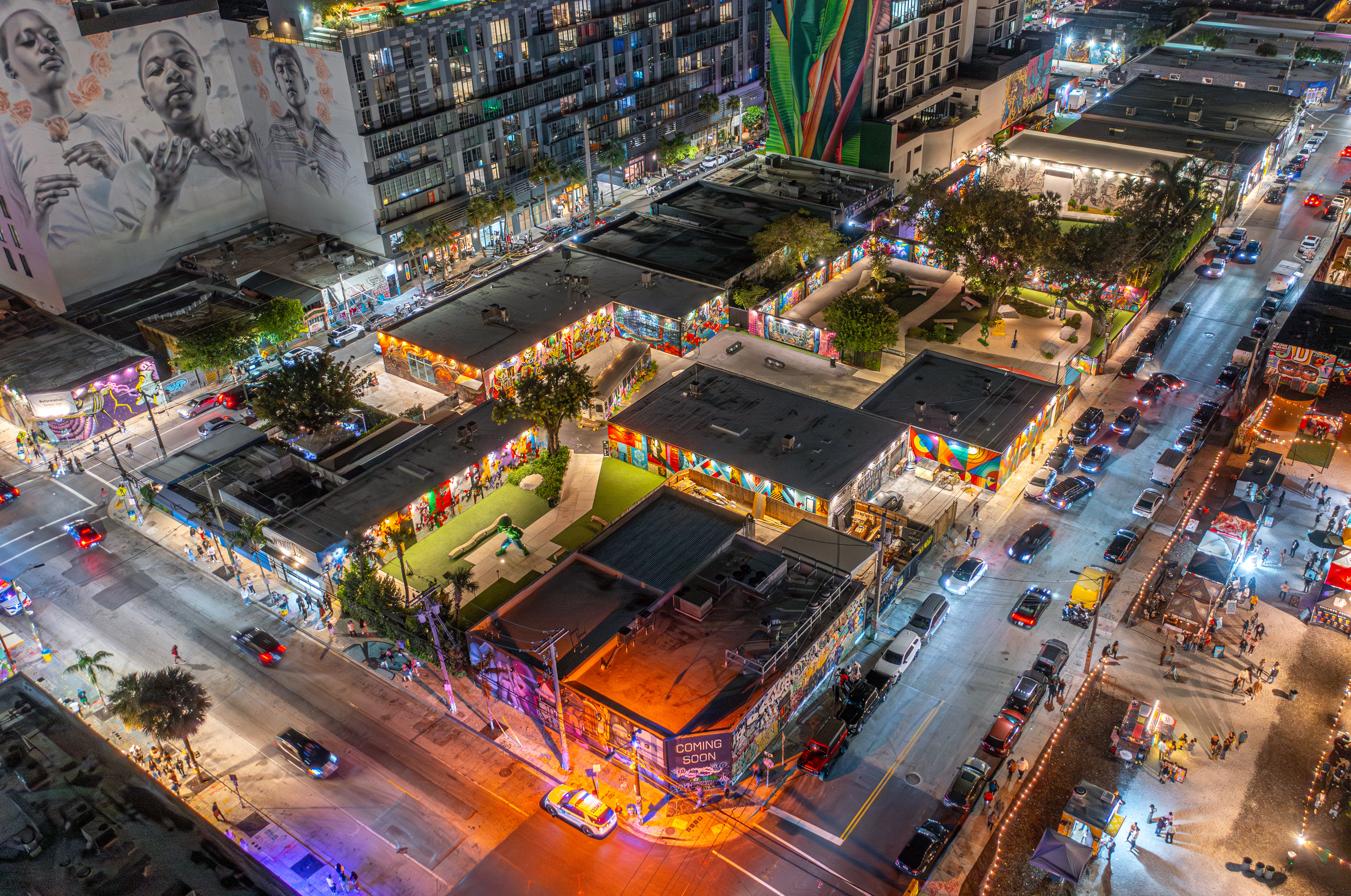
They're not. Wynwood is the gritty arts neighborhood — street art, breweries, warehouses, the fastest appreciation in Miami over the past year (+18.5% YoY), and a young residential / creative-class character. Design District is the curated luxury-fashion enclave — Hermes, Cartier, Louis Vuitton, Dior, Bulgari storefronts; Michelin-recognized restaurants; an explicitly polished aesthetic.
This guide is the side-by-side. Different residential stock, different daily texture, different buyer.
The Quick Answer
Pick Wynwood if you want emerging-neighborhood appreciation upside, gritty creative character, deep brewery and live-music nightlife, and lower entry prices for new condo product. Best for younger buyers (35–45), creative-class professionals, art collectors, rental investors targeting yield, and value-conscious urban buyers.
Pick Design District if you want curated luxury-fashion daily life, the polished aesthetic of an intentionally designed neighborhood, Michelin-recognized dining within walking distance, and the social cachet of the Design District address. Best for fashion-affiliated buyers, established luxury consumers, pied-a-terre owners, and buyers prioritizing aesthetic curation over creative-class energy.
Geography & Character
Wynwood sits between Midtown Miami to the north, Edgewater to the east, Downtown Miami to the south, and the railroad corridor to the west. The neighborhood is roughly bounded by NW 36th Street (north), NW 20th Street (south), NE 2nd Avenue (east), and I-95 (west). The "Wynwood Arts District" is the more curated commercial core including the famous Wynwood Walls outdoor mural collection.
Wynwood's transformation began in the late 2000s when Tony Goldman acquired blocks of warehouses and turned them into Wynwood Walls, anchoring an art-district identity. Two decades later, Wynwood is one of the most photographed urban art districts in the world — and the residential conversion is in full swing. New condo towers and converted warehouse residential are increasingly common alongside the original gallery and brewery footprint.
Design District sits immediately north of Wynwood (across NE 36th Street, roughly) and west of Biscayne Boulevard. The neighborhood is concentrated on NE 38th–42nd Streets between Federal Highway and N. Miami Avenue. It's significantly smaller than Wynwood — only ~3,500 residents in a compact footprint.
Design District's identity was deliberately constructed starting in the early 2000s by Craig Robins (Dacra) — assembled blocks of mid-century warehouses converted into a curated luxury retail district. Today the Design District hosts flagship boutiques for Hermes, Cartier, Louis Vuitton, Dior, Christian Louboutin, Bulgari, Goyard, Givenchy, Tom Ford, Berluti, Loro Piana, Brunello Cucinelli — easily the densest luxury-fashion retail in Florida. Plus the Institute of Contemporary Art Miami (ICA) anchors the cultural footprint.
Character: Wynwood is gritty arts emerging — street art, breweries, food trucks, warehouse-converted retail, weekend tourists, art-walk Saturdays. Design District is polished luxury curated — flagship boutiques, Michelin-recognized restaurants, public art installations (the Buckminster Fuller Fly's Eye Dome, the John Baldessari "I Will Not Make Any More Boring Art" wall), and an aesthetic that reads as designed-on-purpose.
The Numbers (Side by Side)
| Wynwood | Design District | |
|---|---|---|
| Population | ~7,500 | ~3,500 |
| Median age | 35 | 33 |
| Median household income | $42,000 | $60,000 |
| Average condo price | $680,000 | $1,100,000 |
| Price per sq ft | $520 | $850 |
| Median rent | $2,800 | $4,200 |
| Rent per sq ft | $2.90 | $4.10 |
| Active inventory | ~320 listings | ~180 listings |
| Months of inventory | 2.8 | 3.2 |
| YoY price change | +18.5% | +13.8% |
| Walk Score | 94 | 88 |
| Transit Score | 55 | 70 |
| Bike Score | 88 | 70 |
| Crime rating | B | B |
| School rating | B | B |
| Nightlife rating | 5/5 | 4/5 |
| Restaurant rating | 5/5 | 5/5 |
| Shopping rating | 3/5 | 5/5 |
Reading the numbers:
- Wynwood has the fastest YoY appreciation in our entire neighborhood dataset (+18.5%). Months of inventory at 2.8 is genuinely tight — Wynwood is currently the most demand-heavy market in Miami.
- Design District is meaningfully more expensive ($/sqft $850 vs $520, average price $1.1M vs $680K). The premium reflects newer luxury inventory and the curated retail environment that drives address premium.
- Both are walkable (94 vs 88) and both score high on bike (88 vs 70). Wynwood's slightly higher walk reflects the denser day-to-day commercial density (more bars, more coffee shops, more food trucks per block). Design District's slightly lower walk reflects the more retail-focused street pattern.
- Design District has higher Transit Score (70 vs 55) — Brightline's MiamiCentral is closer to Design District than Wynwood's eastern blocks, and Design District has better access to the Omni and Adrienne Arsht Metromover stations.
- Wynwood wins on nightlife (5/5 vs 4/5). Wynwood's bar / brewery / live-music density is real and louder than Design District's.
- Design District wins on shopping (5/5 vs 3/5). Design District's luxury-fashion retail is in a category Wynwood doesn't try to compete in.
- Both score B on schools and crime. Neither is a strong family-school neighborhood; both are functionally safe but with the typical urban-emerging incident concentration in certain blocks.

Building Stock
Wynwood
Wynwood's residential stock is dominantly newer-construction mid-rise condo plus converted warehouse residential. The neighborhood has been residentially under-built historically; the new construction wave is currently delivering thousands of new units.
Notable existing residential:
- Wynwood 25 — Related Group new construction
- Wynwood 27 — companion building
- Walls at Wynwood — boutique residential
- The Wynwood House — converted warehouse
- Several smaller infill condo conversions throughout the arts district
Pre-construction in Wynwood is an active pipeline with several Class A multifamily and luxury condo projects under construction at any given time. See Wynwood best buildings ranking for the curated list.
Design District
Design District's residential stock is smaller and more curated — a handful of newer luxury condo developments plus some adjacent residential.
Notable residential:
- Baltus House — boutique luxury, ~30 units
- Le Parc at Brickell... wait, this is Design District — verify per building page
- Cipriani Residences Wynwood (border location) — pre-construction, on the Wynwood/Design District border
- Several smaller boutique projects
The Design District is more retail-and-cultural than residential by design — the planned mix is heavier on storefront retail and gallery/museum space than typical neighborhoods. Residential is the smaller share of the building program. See Design District best buildings ranking.
Building-stock takeaway: Wynwood has more residential inventory and more new construction at lower entry tiers. Design District is narrower but more uniformly upscale. If you want a $600K mid-rise condo close to the action, Wynwood. If you want a $1.5M boutique-luxury unit in a curated retail environment, Design District.
Lifestyle, Dining, Retail
This is the clearest character difference.
Wynwood lifestyle:
- Wynwood Walls — the iconic outdoor street art museum, anchor of the neighborhood identity
- Wynwood Brewing Co. + J. Wakefield + Veza Sur + Concrete Beach — Wynwood's brewery row, several blocks of independent craft beer
- Coyo Taco, Wynwood Yard (Doce Provisions, Sweet Liberty, R House, Hometown BBQ, Coyo Taco), Salty Donut, Joey's — the food / drink core
- Mana Wynwood + Mana Common — performance and event venues
- Art Walk every second Saturday (Wynwood Art Walk) — monthly gallery + studio open hours
- Live music at multiple venues
- Casual aesthetic — flip-flops at brunch, art-walk crowds
Design District lifestyle:
- Luxury fashion flagship row along NE 39th/40th Streets — Hermes, Cartier, Louis Vuitton, Dior, Bulgari, Brunello Cucinelli, Givenchy, Tom Ford, Loro Piana, Christian Louboutin, Berluti, Goyard, and dozens of others
- Institute of Contemporary Art Miami (ICA) — anchor cultural venue, free admission
- Public art program — Buckminster Fuller's Fly's Eye Dome, the John Baldessari wall, Marc Newson installations
- Restaurant scene — Sushi by Bou, Estefan Kitchen, Mandolin Aegean Bistro, Michael's Genuine Food & Drink, Mr. Chow at the W Hotel adjacent, multiple Michelin-recognized chefs
- Palm Court — the open-air plaza at the heart of the district with public seating, shaded by structural canopy
- Curated aesthetic — designer-shopping daytime, dining-and-cocktails evening
- Less alive after 11pm than Wynwood
Lifestyle takeaway: Wynwood is the active-creative-class daily neighborhood. Design District is the luxury-fashion-and-design daily neighborhood. Neither is "better" — they fit different people.
Investment & Market Dynamics
Wynwood:
- Fastest YoY appreciation in our data (+18.5%) — momentum reflects new construction delivery, brewery / dining / arts maturation, and Brightline-corridor proximity
- Months of inventory: 2.8 — genuinely tight market, sellers' favor
- Rental yields are strong at the entry tier ($2.90/sqft median rent, $520/sqft purchase = ~6.7% gross rental yield on the rough math)
- Pre-construction pipeline is active; expect continued supply delivery over the next 3–5 years
- Short-term rental rules vary by building; many newer Wynwood buildings have been more permissive than Brickell
Design District:
- 13.8% YoY appreciation (still strong)
- Months of inventory: 3.2
- Premium rent at $4.10/sqft — design-district-address premium is real
- Less new construction supply incoming — limited buildable land and zoning constraints
- Most buildings restrict short-term rentals to protect the curated retail environment
Investor verdict: Wynwood for highest-momentum appreciation + entry-tier rental yields. Design District for premium-rent positioning + address-driven appreciation.
Who Wynwood Is For
- The creative-class urban buyer. Designers, gallery owners, agency workers, startup founders, artists. Wynwood is built for this demographic.
- The young professional (35–45) prioritizing nightlife and walkable creative-class amenities over school zoning or family services.
- The art collector or art-affiliated buyer. Wynwood is the de facto Miami contemporary art neighborhood — galleries, studios, art events, the art-walk culture.
- The value-momentum buyer. Lower entry prices than Design District, with currently the steepest appreciation curve in Miami. High-variance bet on continued maturation.
- The rental investor. Wynwood's strong $/sqft rent + lower acquisition cost creates favorable cap-rate math compared to most Miami neighborhoods.
Who Design District Is For
- The luxury fashion / design enthusiast. If your weekly retail routine includes shopping at the flagship Hermes / Cartier / Louis Vuitton stores, Design District is essentially a walk-from-home extension of your lifestyle.
- The buyer who values curated aesthetic. Design District is built to be beautiful. Streets, public art, building facades, signage — all designed-on-purpose. If aesthetic curation matters, Design District provides it at neighborhood scale.
- The pied-a-terre owner for whom address signals identity. Design District is a younger, more design-conscious version of "I have a place at Bal Harbour Shops."
- The Michelin / fine-dining buyer. Design District's restaurant cluster outweighs Wynwood's at the high-end fine-dining tier.
- The art-buyer who prefers museum-and-gallery to graffiti-and-warehouse. ICA Miami plus the curated public art program is a different art experience than Wynwood Walls + galleries.
Frequently Asked Questions
Q: Which is cheaper, Wynwood or Design District? A: Wynwood, meaningfully. Average $680K vs $1.1M; $520/sqft vs $850/sqft. Wynwood has the better entry price at every tier of comparable product.
Q: Which has better appreciation potential? A: Both have strong YoY momentum (+18.5% Wynwood, +13.8% Design District). Wynwood is currently the fastest-appreciating neighborhood in Miami. Long-term: Design District's supply constraint supports continued appreciation; Wynwood's much larger pipeline could moderate the rate as new construction delivers.
Q: Are they safe? A: Both B-rated. Both are safer than they used to be (Wynwood especially has improved dramatically since the early 2010s) but neither is in the top safety tier in Miami. Late-night blocks vary; pick your residential location carefully within each neighborhood.
Q: Can I walk between them? A: Yes, easily. Wynwood and Design District share a border at NE 36th Street; the southern Design District blocks are a 5–10 minute walk from northern Wynwood. Many residents of one regularly visit the other.
Q: Which has better dining? A: Comparable density, different character. Wynwood is casual-creative (Coyo Taco, R House, Sweet Liberty). Design District is upscale-curated (Sushi by Bou, Estefan Kitchen, Michael's Genuine, multiple Michelin-recognized). Pick by mood.
Q: Which has better nightlife? A: Wynwood, clearly. Wynwood Brewing Co + J. Wakefield + multiple bars + Wynwood Yard + Mana event programming + casual outdoor seating throughout. Design District winds down earlier and is more polished-dinner than late-night-bar oriented.
Q: Which is better for short-term rental? A: Building-specific. Wynwood has more STR-permissive buildings on average; Design District's residential is smaller and largely STR-restricted. Always check the specific building's condo declaration.
Q: Is Cipriani Residences in Wynwood or Design District? A: Cipriani Residences (the pre-construction project) sits on the Wynwood / Design District border. It's listed in our system as Wynwood but functions as a Design District-adjacent address; many buyers think of it as Design District-adjacent.
Q: Do they have residential or are they mostly retail/commercial? A: Both are increasingly residential, but in different proportions. Wynwood has more residential by raw unit count and is currently the larger residential construction pipeline. Design District is smaller-residential overall but newer luxury product.
Q: Which has better schools? A: Both B-rated. Neither is a strong K–12 family neighborhood. Most luxury-buyer families in either neighborhood use private schools (Lehrman Community Day School in Mid-Beach, or Coconut Grove / Coral Gables private schools).
Q: How do I decide between them? A: Visit a Saturday at 11am, then again at 9pm. Wynwood Saturday is busy with brunch crowds, art-walk visitors, and brewery patrons. Design District Saturday at 11am is shopping crowds at the flagship boutiques. Wynwood at 9pm is full bars and live music. Design District at 9pm is finishing dinner and starting to quiet down. Pick the energy you want to live with.
For specific buildings in either neighborhood, browse the Wynwood building directory and Design District building directory. For broader Miami context, see the Miami neighborhoods guide and the branded residences guide. To talk through which fits your specific situation, get in touch.
Condo buildings in Wynwood
Photos, floor plans, amenities, and current units for sale and rent in each.
- Canvas Wynwood
- DUOS Wynwood
- Frida Kahlo Wynwood Residences
- NoMad Wynwood
- The Cloud One Hotel & Residences Wynwood
- The Rider Residences
- Twenty-Six & 2nd Wynwood Residences
- Wynwood 25
Tags
Related Articles
Aventura vs Sunny Isles: Which Northern Miami Neighborhood Should You Buy In?
Direct comparison of two adjacent northern Miami-Dade neighborhoods that look similar on a map and aren't. Aventura — mainland city built around Aventura Mall and Williams Island, family-skewing, A-rated schools. Sunny Isles — barrier-island Atlantic beachfront tower corridor with Porsche, Bentley, Ritz, Armani, Trump. Prices, schools, lifestyle, who each fits.
Coconut Grove vs Coral Gables: Which Miami Neighborhood Should You Buy In?
A direct comparison of Miami's two upscale family neighborhoods. Coconut Grove — bohemian bayfront village with marinas and historic charm. Coral Gables — meticulously planned Mediterranean Revival city, prestigious schools, U-Miami home. Real prices, demographics, schools, lifestyle, and who each is built for.
Key Biscayne vs Fisher Island: Which Miami Island Life Is Right for You?
A direct comparison of Miami's two most exclusive island communities. Key Biscayne — bridge-accessible barrier island family community with A-rated schools, ocean and bay frontage, and Crandon Park. Fisher Island — America's wealthiest zip code, accessible only by ferry, yacht, or helicopter, with 830 residents and average prices above $6M.