Aston Martin Residences Lawsuits: What Owners Allege, What the Developer Says, and What the Resale Data Shows (2026)
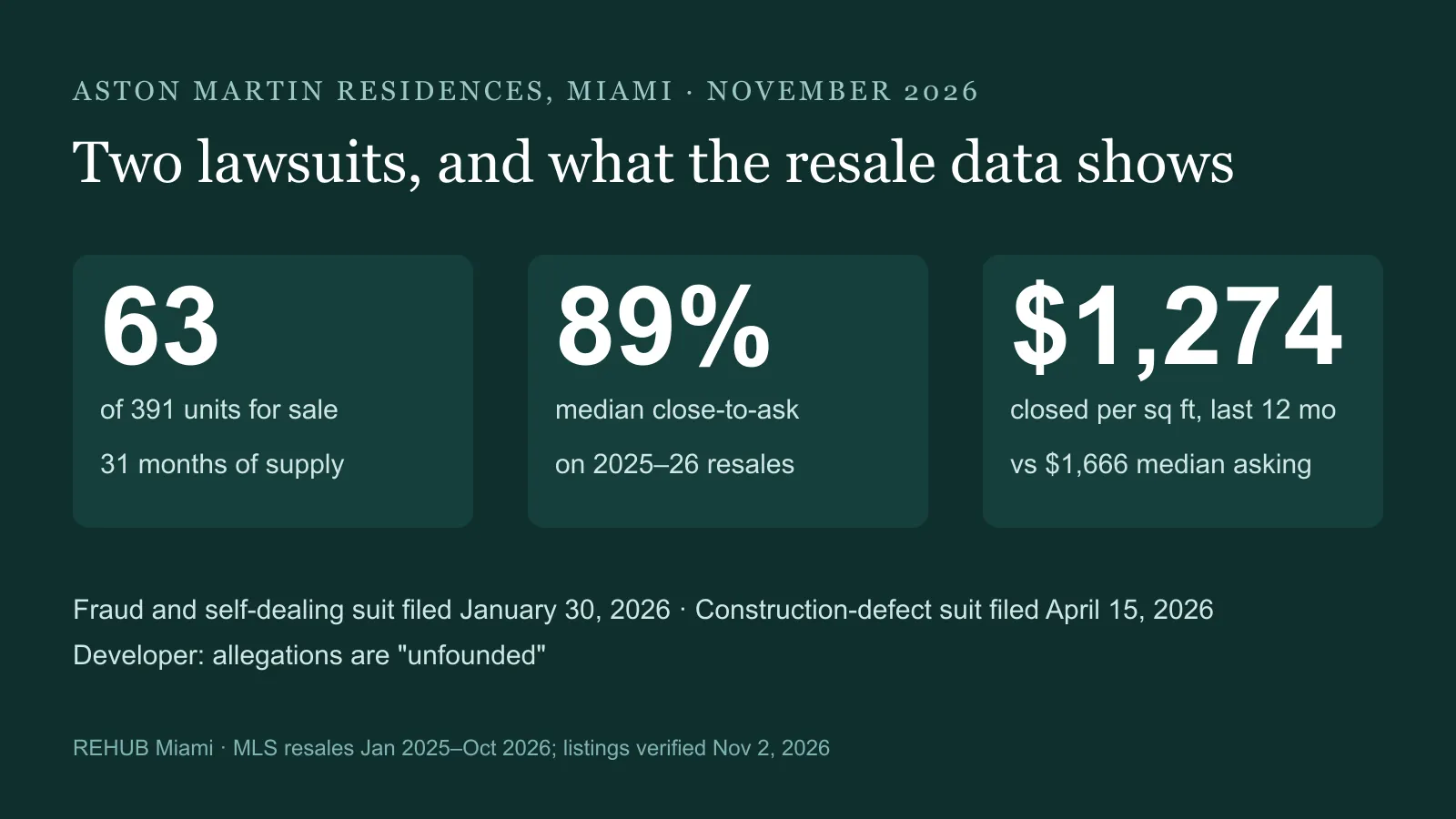
The condo association at Aston Martin Residences has sued its developer twice in 2026: a $5 million fraud and self-dealing case filed January 30, and a construction-defect case filed April 15 against the developer, the contractor, the architect and the structural engineer. The developer calls the claims unfounded. We lay out both complaints, the developer's response, Florida's rules for these cases, and what 48 resales and 63 active listings say about the building's market.

Aston Martin Residences Lawsuits: What Owners Allege, What the Developer Says, and What the Resale Data Shows
Short answer: the 300 Biscayne Boulevard Way Condominium Association, which runs Aston Martin Residences, filed two lawsuits against the tower's developer in 2026. The first, filed January 30 in Miami-Dade Circuit Court, accuses developer Germán Coto, seven other people and a group of his companies of self-dealing, constructive fraud and unjust enrichment, and seeks at least $5 million plus a full accounting. The second, filed April 15, accuses the developer entity Riverwalk East Developments and 15 other firms, including the general contractor, the architect and the structural engineer, of negligence over cracking and spalling concrete, leaking pool structures, exposed reinforcing steel and other defects, and seeks at least $750,000 plus an order compelling repairs. The developer says the allegations are "unfounded." Neither case has been decided.
The building is the first residential project to carry the Aston Martin name: 66 stories and 391 residences at the mouth of the Miami River, opened in April 2024 and reported 99% presold at opening. That makes the cases a test of what a brand guarantees, and a live question for anyone weighing one of the 63 units now for sale.
This article explains both complaints as reported, gives the developer's response in full, sets out the Florida rules that govern cases like these, and then looks at what the building's own resale and listing data show. Nothing here is legal advice; the allegations are allegations until a court rules.
On this page: Key facts · Timeline · Lawsuit 1: fraud and self-dealing · Lawsuit 2: construction defects · Developer's response · Florida rules · Resale data · For buyers · For owners · FAQ · Sources
Key facts
| Lawsuit 1 | Lawsuit 2 | |
|---|---|---|
| Filed | January 30, 2026 | April 15, 2026 |
| Court | Miami-Dade County Circuit Court | Miami-Dade County Circuit Court |
| Plaintiff | 300 Biscayne Boulevard Way Condominium Association | 300 Biscayne Boulevard Way Condominium Association |
| Defendants | Riverwalk East Development LLC, Germán Coto, Marcelo Scarinci, Guillermo Caccagno, Gloria A. Garcia, Leonardo Polo, Maria Elaina Polo, Daniel Ricardo Andrada and about ten related companies, including G&G Business Developments | Riverwalk East Developments LLC and 15 other firms, among them Coastal Construction South Florida (contractor), Revuelta Architecture International (architect) and DeSimone Consulting Engineering (structural engineer); TK Elevator was asked for comment |
| Claims | Breach of fiduciary duty and self-dealing (against the three pre-turnover board members), civil conspiracy to commit constructive fraud, unjust enrichment | Negligence and building-code violations in the design and construction of building systems and components, brought after Florida's Chapter 558 pre-suit notice |
| Relief sought | At least $5 million; a full accounting of the association's finances; cancellation of a remaining insider contract | At least $750,000 and an order compelling repairs; the association's lawyers say repairs will run into the millions |
| Association counsel | David Haber, Ariella Gutman and Nicholas Lasbrook of Haber Law | David Haber and Daniel Levin of Haber Law |
| Developer position | Counsel Lewis Conwell declined comment in February; a Riverwalk East spokesperson later called the allegations "unfounded" | Same statement; the developer says it hired experienced suppliers and professionals and expects "a fair and favorable determination" |
| Status | Pending; no ruling reported as of November 2, 2026 | Pending; no ruling reported as of November 2, 2026 |
Timeline
- 2014: G&G Business Developments, led by Germán Coto, son of Argentine supermarket owner Alfredo Coto, buys the 1.3-acre riverfront site at 300 Biscayne Boulevard Way for $125 million.
- 2016: Sales launch, with delivery planned for 2020. Marketing shows more than 40,000 square feet of amenities across four sky floors, a private marina, a rooftop helipad, butler service and beach club access. In 2020, buyers were offered a $176,900 car with a purchase, when prices started at $5.3 million.
- 2017: Groundbreaking.
- April 2024: The 66-story, 817-foot tower opens, reported 99% presold. Residents begin moving in around March.
- March 2025: Control of the association passes from the developer to the unit owners.
- Fall 2025: The board hires outside accountants and a new management company and moves to end the developer's service contracts. In June it had given notice to cancel the lease on the unit used as the association office.
- November 24, 2025: A post-tension grease cap detaches and lands on the pool deck, damaging property; no one is hurt, according to the defect complaint as reported.
- January 30, 2026: The association files the fraud and self-dealing suit.
- April 15, 2026: After the Chapter 558 notice process, the association files the construction-defect suit against 16 firms.
- April–May 2026: A Riverwalk East spokesperson issues the developer's only public statement so far, calling the allegations unfounded.
- November 2, 2026: No ruling, settlement or dismissal has been reported in either case.
Lawsuit 1: fraud and self-dealing
The first complaint concerns how the building was run between opening and turnover, when the developer controlled the association's board. Its three pre-turnover officers, according to the complaint as reported by the South Florida Business Journal, were Coto, Marcelo Scarinci (treasurer and secretary, an employee of a separate Coto business) and Guillermo Caccagno (vice president, a former Coto Supermarkets executive).
The association alleges that during that period the developer-controlled board:
- Signed no-bid service contracts with companies controlled by Coto or his associates for building management, concierge, security, valet, cleaning, IT and repairs, at prices the association says were above market, without disclosing the relationships. The complaint says the contracts were signed "just before the turnover." The management firm, the Miami Herald reported, was controlled by the Coto family and collected what the suit calls hefty fees.
- Leased the association its own office from an insider. The developer had reserved Unit 303 as association office space, then sold it to an entity called Biscayne 303, which traces to G&G. The association paid about $70,000 to rent the space, which it says only Coto's businesses used, and gave notice in June 2025 that it would cancel. Biscayne 303 has sued the association for breach of contract, seeking more than $100,000 and possession of the unit.
- Kept invoicing after turnover, including for services already paid, and did not hand over complete books and records, access to the pre-turnover email domain, or data on company devices. The association says the turnover audit was not legally sufficient.
- Did not deliver amenities buyers were promised. The reporting lists a helipad, a private marina, beach club access and butler service among the marketed features. One owner, Keith Swirsky, told CBS Miami: "No butlers ever appeared."
Association president Michael Diaz says most of the insider contracts were cancelled after turnover. The one still in place, he told the Business Journal, is a technology contract with Multironik, because the exit penalty was too large; the lawsuit asks the court to nullify it. The association's lawyer, David Haber, told CBS Miami, "It's clearly a bait and switch," and told Bisnow the conduct was "brazen, intentional and arrogant." Haber has said no exact figure for the losses exists yet, beyond "millions and millions of dollars," and that criminal referrals have not been decided.
Lawsuit 2: construction defects
The second case followed the property-condition assessment the association commissioned from Epic Forensics & Engineering after taking control in March 2025. Florida requires an association to serve a written notice of claim on the builder before suing over defects (more on that below); the association did so, and filed on April 15, 2026, after the notice period ran.
The alleged defects, as reported from the complaint and the engineering assessment:
| Area | What the association alleges |
|---|---|
| Balconies | Spalling and loose concrete on slab edges, chunks that have fallen, holes exposing reinforcing steel, rust and water intrusion; a drone survey found significant deflection on three floors; drainage slopes built improperly. Epic flagged the balcony concrete as an immediate life-safety issue. The loose material has been removed at the association's cost, but permanent repairs remain |
| Pool, spa and water features | Not properly designed, installed or inspected, with cracks and leaks that are corroding reinforcing steel and other structural components |
| Post-tension system | Deficiencies including exposed tendons; the grease-cap incident of November 24, 2025 |
| Structure | "Sizable cracking" in concrete surfaces; a crack gauge in the 53rd-floor electrical room reportedly grew over several months; stucco falling off in places |
| Seawall | Cracks and corrosion |
| Building systems | Loose fire-sprinkler joints causing leaks and corrosion; plumbing, mechanical and electrical deficiencies; elevator defects |
| Envelope and finishes | Waterproofing failures; unsealed openings; masonry, doors, railings, paint and exterior pavers |
The suit alleges negligence and building-code violations by the developer, the contractor and subcontractors. It asks for at least $750,000 and an order compelling repairs; Haber told Bisnow he expects the cost to exceed millions. Daniel Levin, who filed the case, argues the problems were visible at turnover and so cannot be blamed on the association's maintenance. Haber's summary to Bisnow: "Spalling concrete shouldn't occur in any high-rise," adding that "virtually every high-rise is dealing with construction defects," and that developers should build correctly and fix what they get wrong.

What the developer says
Riverwalk East and Coto's companies did not respond to CBS Miami, Bisnow or the Miami Herald when the first suit was filed, and counsel Lewis Conwell told the Business Journal he had not yet reviewed the complaint. After the second filing, a spokesperson for Riverwalk East Developments who asked not to be named gave Bisnow and CBS Miami a statement. Its points, as reported:
- The association "has made some seriously outlandish allegations against some very good people and companies," which the developer believes are "unfounded."
- The allegations appear intended to divert attention from the board's own "unresolved obligations," which the developer describes as a decision not to honor its statutory obligations. The statement does not say what those obligations are.
- The developer hired experienced suppliers and professionals, and the building upheld "premium standards of design and construction."
- It has responded "through proper legal channels," supports a resolution based on facts and good faith, is concerned that litigation may not serve residents' interests, and "remains confident that, once all facts are fully reviewed, the court will reach a fair and favorable determination."
Aston Martin itself is not a defendant in either case and has not commented in any of the coverage we reviewed. TK Elevator declined to comment; the other construction defendants did not respond to Bisnow.
What Florida law says about cases like these
Three parts of Florida law shape how these two cases will run.
Chapter 558 pre-suit notice. Before an association representing more than 20 units can sue over construction defects, it must serve a written notice of claim at least 120 days before filing; the builder then has 75 days to inspect and respond with a repair offer, a settlement offer or a denial. The process exists to let contractors fix defects before litigation. The association says the developer and contractor refused to accept responsibility during that window, which is why the April suit followed.
Developer and contractor warranties. Under Florida's condominium act, a developer gives an implied warranty of fitness on each unit for three years from completion of the building, and on the roof, structure and the mechanical, electrical and plumbing elements serving the building for three years from completion or one year after owners take control, whichever is later, capped at five years. The contractor and subcontractors warrant structural and mechanical work for three years from completion and other work for one year. For a tower completed in 2024 and turned over in March 2025, those windows are still open, which is one reason associations move quickly after turnover.
Turnover duties. When control passes to owners, the developer must deliver the association's records, contracts and a turnover audit. The first complaint's claims about incomplete records and an insufficient audit fall under those rules, and the insider-contract claims rest on the fiduciary duty that developer-appointed directors owe the association.
Expect both cases to take years rather than months. Defect cases of this size typically involve expert reports from both sides, mediation, and settlements that fund repairs; the developer's statement, pointing at the board's "statutory obligations," suggests it may raise counterclaims. Until then, the cost of interim repairs falls on the association, and therefore on owners.
What the resale data shows
Litigation is one input into a building's market; the others are price, supply and what buyers get for the money. Here is what the MLS record says about Aston Martin Residences. Closed sales are resales recorded in the MLS from January 2025 through October 2026 (developer closings are not in the MLS). Listings were counted on November 2, 2026, and each was checked against the live MLS feed.
| Measure | Figure |
|---|---|
| Units for sale | 63 of 391 (16%), plus 12 under contract |
| Units for rent | 28, asking $5,400 to $240,000 a month, median $18,750 |
| Median asking price | $3.1 million; $1,666 per square foot |
| Resales closed, Nov 2025–Oct 2026 | 24, median $2.48 million, $1,274 per square foot |
| Months of supply | About 31 |
| Median close-to-ask on 2025–26 resales (48 sales) | 89%; the five widest gaps closed at 71% to 78% of the final asking price |
| Price cuts on current listings | 27 of 63 reduced, median cut 7.1% |
| Median days on market, current listings | 105; 18 listings past 180 days |
| Monthly association fee | Median $1.79 per square foot on current listings |
| Largest listing | The 19,868-square-foot triplex penthouse, relisted at $75 million in late October 2026 (it was marketed at $59 million) |
Three things stand out.
The gap between asking and closing prices is wide, and it predates the lawsuits. Resales were already closing at a median 86% of asking in the first half of 2025, before the association's accusations became public; the figure was 91% in the second half of 2025 and 90% in the first half of 2026. Sellers in this building ask about $1,666 per square foot and buyers pay about $1,274. That is a negotiating fact more than a litigation effect.
Supply is the problem. Sixteen percent of a 391-unit building is for sale, and at the past year's pace of two resales a month that is about 31 months of inventory. Many of the listings are from original buyers who bought at 2016–2019 prices, which explains the patience, but it also means a buyer has choice and leverage.
| Period | Resales | Median price | Median $/sq ft | Median close-to-ask |
|---|---|---|---|---|
| H1 2025 | 11 | $4.08M | $1,326 | 86% |
| H2 2025 | 16 | $2.75M | $1,172 | 91% |
| H1 2026 (both suits filed) | 17 | $2.30M | $1,276 | 90% |
| Jul–Oct 2026 | 4 | $2.61M | $1,306 | 86% |
Sales did not stop when the suits were filed, but they have slowed since summer. Seventeen resales closed in the first half of 2026, the busiest half-year since opening, at a median $1,276 per square foot. Only four closed from July through October. Four sales is too few to call a trend, and the small samples mean the medians move with which units happened to sell. What the data does not show is a price collapse: the per-square-foot median has held between $1,170 and $1,330 for two years.
For context, Downtown Miami's bayfront and Biscayne Boulevard towers sold for a median of about $654 per square foot in the same period, so Aston Martin Residences still trades at roughly double its neighbors, the premium a branded, amenitized waterfront tower was built to command. Our Biscayne Bay view condos comparison has the surrounding numbers.
If you are considering a unit
The building's price, location and amenity floors have not changed. What has changed is the amount of homework a buyer should do before signing, and the leverage a buyer has.
- Read both complaints and the developer's answers. They are public records in Miami-Dade Circuit Court, and the association's counsel has published summaries. Ask the listing agent for the Chapter 558 notice and the Epic Forensics property-condition assessment; a seller's disclosure should reference pending litigation.
- Ask the association three questions in writing. What has been spent on interim repairs so far, and from which fund? Is a special assessment planned, and for how much? What do the current reserves and the latest structural reserve study show? Florida now requires funded reserves for structural items in buildings over three stories, so the answer will shape the monthly fee. Our guide to milestone inspections and SIRS explains the reports to request.
- Check whether your lender will lend. Conventional mortgage guidelines treat a condominium as ineligible while litigation involves the project's structural soundness, safety or habitability, unless the lender can document that the claims are minor or the association has the funds to cover them. Ask your lender to review the project before you go under contract; if it declines, you are a cash buyer competing with other cash buyers, which cuts both ways.
- Price from closed sales, not asking prices. Comparable resales closed at $1,170 to $1,330 per square foot over the past two years and at a median 89% of the final asking price. With 63 listings to choose from and 27 already reduced, there is no reason to pay list.
- Weigh the amenities you can see. The sky pool, spa, gym and lounges on floors 52 to 55 exist and operate. The helipad, marina and beach club access are among the features the association says were promised and not delivered; do not pay for them until you have confirmed what the association actually controls.
- Think about the exit. Litigation that drags on keeps some buyers and lenders away, which can mean a longer resale and a larger discount. A settlement that funds repairs usually has the opposite effect. Buy at a price that works if the first scenario lasts two or three years.
If you already own there
- Interim repairs come out of the association's budget until the cases resolve, so expect the board to discuss assessments or reserve use at upcoming meetings. Attend, and ask for the engineering reports behind each repair.
- A settlement or judgment funds repairs, not refunds. Defect recoveries go to the association to fix the building; the self-dealing case seeks money back to the association's accounts. Neither puts cash in individual owners' hands.
- Keep your own records. Owners who documented conditions at move-in, as several have in the press, help the association's case and their own disclosures at resale.
- Disclose when you sell. Florida sellers must disclose known material facts; pending litigation against the developer over structural defects is one. Buyers will find it regardless.
Frequently Asked Questions
What is the Aston Martin Residences lawsuit about?
There are two. The first, filed January 30, 2026, accuses developer Germán Coto, his companies and the developer-era board of self-dealing: no-bid service contracts with insider companies, a $70,000 office lease from an affiliate, incomplete turnover records and undelivered amenities. It seeks at least $5 million and an accounting. The second, filed April 15, 2026, accuses Riverwalk East Developments, Coastal Construction, Revuelta Architecture, DeSimone and 12 other firms of negligence over concrete, balcony, pool, post-tension, seawall and building-system defects, and seeks at least $750,000 plus repairs.
Who is being sued at Aston Martin Residences?
In the first case: Riverwalk East Development LLC, Germán Coto, Marcelo Scarinci, Guillermo Caccagno, Gloria A. Garcia, Leonardo Polo, Maria Elaina Polo, Daniel Ricardo Andrada and about ten companies, including G&G Business Developments. In the second: Riverwalk East Developments and 15 construction and design firms, including Coastal Construction South Florida, Revuelta Architecture International and DeSimone Consulting Engineering. Aston Martin, the carmaker, is not a defendant in either.
What has the developer said?
A Riverwalk East spokesperson called the allegations "unfounded" and "outlandish," said the developer hired experienced professionals and built to premium standards, suggested the suits distract from the board's own unmet statutory obligations, and said the developer expects a fair and favorable ruling once the facts are reviewed. The developer has not detailed which obligations it means.
Is Aston Martin Residences safe to live in?
The association's engineer identified loose balcony concrete as an immediate life-safety issue; the association says that material has been removed and permanent repairs are pending. No evacuation, closure or government order has been reported, and the building remains occupied, with 24 resales closing in the past year. Buyers should read the engineering assessment themselves.
How has the lawsuit affected prices at Aston Martin Residences?
Resales have held between about $1,170 and $1,330 per square foot since 2025, and closed at a median 89% of asking, a gap that existed before the suits were filed. The clearer effect is on velocity: 17 resales closed in the first half of 2026, four from July through October, while 63 units remain for sale, about 31 months of supply.
Can you get a mortgage at Aston Martin Residences?
Possibly not a conventional one while the defect case is open. Lenders following agency guidelines treat projects with litigation over structural soundness or safety as ineligible unless the claims are documented as minor or fully funded. Portfolio lenders may still lend. Ask before contracting.
Sources and method
- Lawsuits: reporting by the South Florida Business Journal (February 5, 2026), Bisnow (February 3 and April 21, 2026), the Miami Herald (February 8, 2026), CBS Miami (February 12 and May 1, 2026), Realtor.com (April 29, 2026) and Propmodo (April 29, 2026), which quote the complaints, the association's counsel and the developer's statement. Where outlets differ on details, we used the most specific primary-sourced account: the January 30 filing date and defendant list are from the Business Journal; the April 15 date, the 16-defendant count and the $750,000 figure are from Bisnow. One outlet gives the unit count as 341; the developer, the county and every other source say 391. We did not review the court dockets directly; case numbers were not published.
- Florida law: Florida Statutes sections 558.004 (notice of claim) and 718.203 (warranties), read November 2, 2026. Lender rules summarized from agency condominium project eligibility guidelines; confirm with your lender.
- Market data: closed condominium resales recorded in the MLS and stored by REHUB Miami, January 2025 through October 2026, and MLS listings on November 2, 2026, each checked against the live MLS feed. Price per square foot uses living area as recorded; records without a price or size are excluded. Months of supply is active for-sale listings divided by average monthly resales from November 2025 through October 2026. Developer closings are not in the MLS and are excluded.
- Status: no ruling, settlement or dismissal in either case had been reported by any outlet we could find as of November 2, 2026. We will update this page when one is.
Keep researching
Our Aston Martin Residences buyer's guide covers the floor plans, amenity floors and unit lines; the building page lists every current sale and rental. For how branded towers price against their neighbors, see our branded residences guide and the supertall condo towers comparison. For the cost side of owning in a tower like this, see HOA fees by building. To see the closed comparables and negotiate from them, contact REHUB Miami.
Condo buildings in Downtown Miami
Photos, floor plans, amenities, and current units for sale and rent in each.
- 38 West Eleventh Residences
- 50 Biscayne
- 501 FIRST Residences
- 600 Miami Worldcenter
- 900 Biscayne Bay
- Aston Martin Residences
- Centralis Residences
- Centro
- Delano Residences & Hotel Miami
- District 225
- E11EVEN Hotel & Residences
- E11EVEN Residences Miami Beyond
- Epic
- Flow House Miami
- Gale Hotel & Residences (Natiivo)
- HUB Miami
- JEM Private Residences
- Legacy Residences at Miami Worldcenter
- Loft Downtown I
- Loft Downtown II
- Marina Blue
- Marquis Miami
- Met 1
- Okan Tower
- One Miami
- One Thousand Museum
- ONE W12 Residences Miami
- Palm Tree Residences Miami
- Paramount Miami Worldcenter
- Ten Museum Park
Tags
Born and raised in Miami, Kyle Benjamin combines a background at Blackstone and Oppenheimer & Co. with hands-on coding and financial analysis. He founded REHUB Miami to make South Florida real estate easier to research through building comparisons, market data, floor plans, and local insights.
Read Kyle’s full bioRelated Articles
Miami Worldcenter Condos Compared: Which Towers Are Worth Buying? (2026)
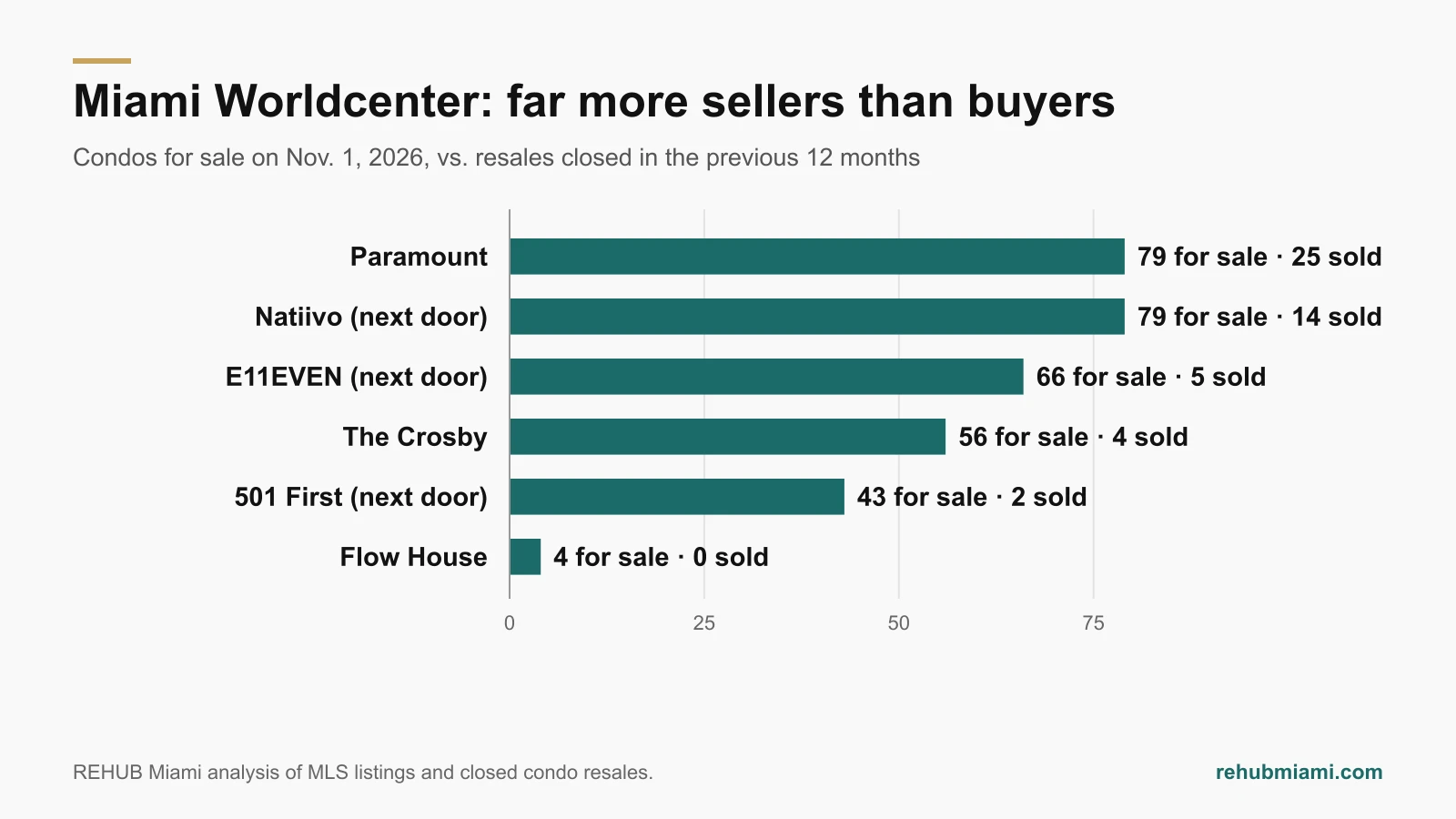
Only six condo towers are actually part of Miami Worldcenter, and only one, Paramount, has a long resale record: a median $610 per square foot in 2025–26, down 8% from 2021–22. Around the district, about 250 condos are for sale in five new furnished towers against 25 resales in the past year. Here is how every tower compares and who each one suits.
Miami Condo Price Per Square Foot: 215 Buildings Ranked (2026)
The median closed price per square foot for every Miami-area condo building with at least five recent sales -- 215 buildings from $3,418 down to $321 plus what the neighborhood medians hide.
Aston Martin Residences Miami: The Sail-Shaped Tower Buyer's Guide (2026)
A complete guide to Aston Martin Residences Miami — the sail-shaped, 66-story, ~391-residence tower at 300 Biscayne Boulevard Way on the Miami River mouth. Developed by G&G Business Developments, designed by Revuelta Architecture and Bodas Miani Anger, delivered 2024. Architecture, the Aston Martin brand, amenities, the superyacht marina, resale pricing, and how to own.